When traveling to Canada, it’s essential to be well-informed about the Canada entrance requirements to ensure a smooth and hassle-free experience. Among other things, this includes the passport, VISA, and vaccination requirements for the country. Additionally, being aware of customs regulations and currency restrictions will help travelers navigate through the arrival process seamlessly.

To assist you in making sure you meet the necessary entrance requirements for Canada, I have provided an outline of all the entrance requirements in this article. Furthermore, I also created a handy checklist that I linked to below that you can use to track the requirements as you meet them.
Download the Canada Entrance Requirements Checklist
Canada Passport Requirements

One of the most important Canada entrance requirements that you will need to consider when planning your trip is the country’s passport requirements. To be allowed into Canada, your passport needs to be valid at the time of entry into the country. If your passport is set to expire before you visit Canada, you will need to get it renewed before your trip.
| Passport Validity | Blank Passport Pages |
|---|---|
| Must be valid at the time of entry into Canada. | One Page Required for Entry Stamp. |
Canada VISA Requirements
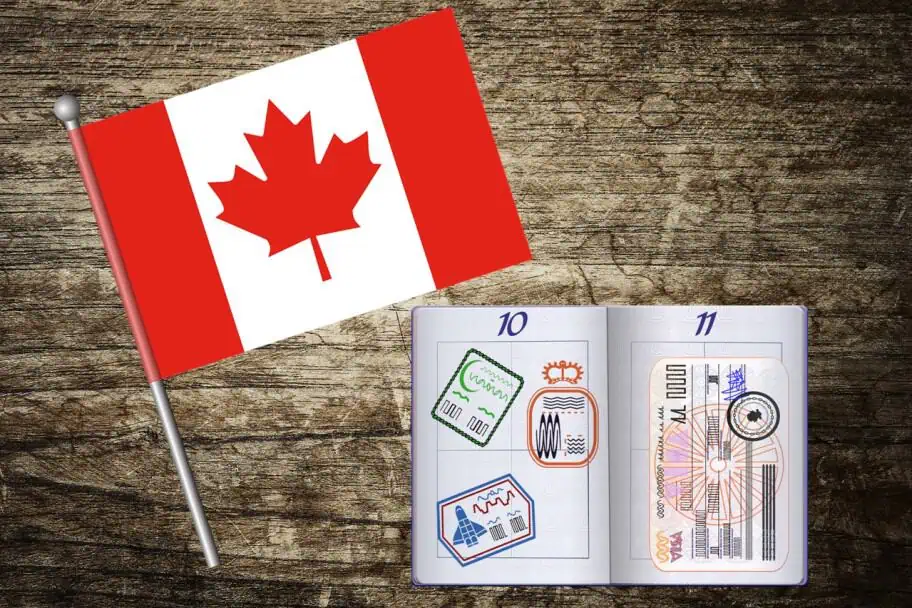
In addition to your passport, one of the most important entry requirements that you will need to consider before traveling to Canada is the tourist VISA requirement. Depending on which country you are from, you may or may not need to apply for a tourist VISA to visit Canada. The following sections outline the Canada tourist VISA requirements and how to apply.
Travelers from the United States
Citizens of the United States can visit Canada for up to 6 months without a VISA. If you plan on staying in Canada for longer than 6 months, you must apply for a VISA.
| VISA Requirement |
|---|
| Citizens of the United States can visit Canada for up to 6 months without a VISA. |
VISA-Exempt (eTA Eligible) Travellers
If you are a passport holder from one of the following countries, you will not need a VISA to stay in Canada for up to 6 months. All you will need to do is register for an Electronic Travel Authorization (eTA) online before flying to Canada. If you are a passport holder from a country listed below and will be visiting Canada by land or sea, no eTA authorization is required.
 |
Andorra |  |
Cyprus |  |
Monaco |
 |
Australia |  |
Czechia |  |
Netherlands |
 |
Austria |  |
Denmark |  |
New Zealand |
 |
Bahamas |  |
Estonia |  |
Norway |
 |
Barbados |  |
Finland |  |
Papua New Guinea |
 |
Belgium |  |
France |  |
Poland |
 |
United Kingdom |  |
Germany |  |
Portugal |
 |
Anguilla |  |
Greece |  |
Romania * |
 |
Bermuda |  |
Hong Kong **** |  |
Samoa |
 |
British Virgin Islands |  |
Hungary |  |
San Marino |
 |
Cayman Islands |  |
Iceland |  |
Singapore |
 |
Falkland Islands |  |
Ireland |  |
Slovakia |
 |
Gibraltar |  |
Israel ***** |  |
Sloveni |
 |
Montserrat |  |
Italy |  |
Solomon Islands |
 |
Pitcairn Island |  |
Japan |  |
Spain |
 |
Saint Helena |  |
South Korea |  |
Sweden |
 |
Turks and Caicos |  |
Latvia |  |
Switzerland |
 |
Brunei |  |
Liechtenstein |  |
Taiwan ** |
 |
Bulgaria |  |
Lithuania |  |
United Arab Emirates |
 |
Chile |  |
Luxembourg |  |
Vatican City State *** |
 |
Croatia |  |
Malta |
| * Electronic Passports Only. |
| ** Passport must be issued by the Ministry of Foreign Affairs in Taiwan and must include a personal ID number. |
| *** Must have a passport or travel document issued by the Vatican. |
| **** Must have a passport issued by Hong Kong SAR. |
| ***** Must have a national Israeli passport. |
| VISA Requirement |
|---|
| Travelers who qualify for eTA VISA Exemption must get an Electronic Travel Autorization (eTA) if flying to Canada. Authorization is not required if traveling to Canada by land or sea. |
All Other Travelers
If you aren’t a citizen of the United States or a citizen of a country that qualifies for eTA VISA-exempt status, you will need to apply for a visitor VISA before booking your travel to Canada.
| VISA Requirement |
|---|
| Travelers who are not VISA-exempt must apply for a visitor VISA before traveling to Canada. |
Canada Immunization Requirements

Important Note: I am not a medical doctor and don’t have medical experience. The information provided in this section is a summary of information that I got from the Centers for Disease Control and Prevention in the United States for travel to Canada. I am providing you this information to help bring awareness of the necessary vaccinations to you, but consultation with my guide should not replace a discussion about your travels with your doctor or a travel medical clinic.
One of the most important, and yet most often overlooked, aspects of travel is the necessary vaccinations that are required or recommended to keep you safe and healthy when you travel. Before you depart for Canada, you are going to want to make sure that you have all of the proper vaccinations. For your convenience, I have summarized the CDC’s recommendations on vaccines and healthcare for travelers visiting Canada for you to review below.
Recommended Travel Vaccinations for Canada
There are several vaccinations that the CDC recommends that you get before traveling to Canada, which I have outlined for you below. Please pay special attention to the details in this guide section and ensure you discuss all vaccinations with your doctor or travel health clinic.
| Vaccine | How Disease Spreads | Details |
|---|---|---|
| Hepatitis A | Food and Water. | Recommended for most travelers. |
| Hepatitis B | Blood and Body Fluids. | Accelerated schedule available. |
Routine Vaccinations for Canada
In addition, the vaccinations that are recommended for travel to Canada specifically, there are other routine vaccinations you should be current on before traveling anywhere in this world. For an overview of the routine vaccinations recommended by the CDC, please review the chart that I have included below.
| Disease Name | How Disease Spreads | Advice |
|---|---|---|
| Measles Mumps Rubella (MMR) | Various Vectors | Given to anyone unvaccinated and/or born after 1957. One time adult booster recommended |
| TDAP (Tetanus, Diphtheria & Pertussis) | Thru open wounds & airborne transmission | Only one adult booster of pertussis required |
| Chickenpox | Direct contact with infected individuals & airborne transmission | Given to those unvaccinated that did not have chickenpox |
| Shingles | Direct contact with infected individuals | Vaccine can still be given if you have had shingles. |
| Pneumonia | Airborne transmission | Two vaccines given separately. All 65+ or immunocompromised should receive both |
| Influenza | airborne transmission | Vaccine components change annually |
| Meningitis | Direct contact with infected individuals & airborne transmission | Given to anyone unvaccinated or at an increased risk, especially students |
| Polio | Spread by contact with infected persons. | Poliovirus has re-appeared in several places throughout the world. You aren’t at risk when traveling to Canada as there are no known outbreaks within the country. However, if you want to be extra safe there is a one-time booster shot that is available for adults. |

Canada Customs Restrictions

Another important aspect of travel to Canada that you must be aware of before you travel is the country’s customs regulations. Like other countries, there are certain goods that you are restricted or even prohibited from bringing into the country. To ensure you don’t make the costly mistake of having one of these restricted items in your baggage, I have outlined the Canada entrance requirements for customs regulations for you to review below.
FREE IMPORT
According to the VISAHQ.com, website, the following items are considered free-import items when entering Canada, but with limits (as described below).
- Personal items, such as clothing, camping and sports equipment, cameras, personal computers, cameras, and other items for personal use.
- You must declare all goods with CBSA upon entry into Canada. If you declare goods upon entry and leave with them on exit, you won’t have to pay a duty or taxes on them. However, to qualify, these goods cannot:
- Be used by any resident of Canada.
- Be used by a business based in Canada.
- Be given as a gift to a Canadian resident.
- Or disposed of or left in Canada.
- You can bring gifts into Canada duty-free as long as they are valued at CAN$60 or less. If they are valued at more, you will need to pay a duty on the gifts upon entry.
- 1.5 liters (53 imperial ounces) of wine, a total of 1.14 liters (40 ounces) of alcoholic beverages, or up to 8.5 liters of beer or ale. Alcoholic beverages are any beverages with more than 0.5% alcohol by volume. Each province will have different amounts of free allowance for alcohol. You will need to pay a duty on quantities beyond the free allowance. In the provinces of
- 200 cigarettes, 50 cigars, 200 grams (7 ounces) of manufactured tobacco, or 200 tobacco sticks.
Important Notes
- You may be asked to pay a security deposit on goods upon entry into Canada. If this happens, you will be provided with a Form E29B that outlines the goods you brought into the country. Keep this form with you as you will need it when you exit to get your security deposit back.
- The minimum age for consuming alcohol differs by province. The minimum age is 18 years for Alberta, Manitoba, and Quebec; and 19 years for the remaining provinces and territories.
- You cannot bring more than the free allowance of alcohol into Nunavut and the Northwest Territories.
PROHIBITED ITEMS
Before you will be allowed into Canada, you will also need to clear customs to be sure you aren’t carrying any prohibited items with you. For instance, travelers are strictly prohibited from bringing the following items into Canada:
- Obscene material.
- Hate propaganda.
- Pornography.
- Used or second-hand mattresses.
- Health products (prescription drugs must be in a prescription bottle).
- Cultural property.
CONTROLLED ITEMS
In addition to these prohibited items, the government of Canada has placed limits on the quantity of other items that can be brought into the country. If you plan to travel with any of the following items when visiting Canada, you will want to plan accordingly so that you do not violate the Canadian entrance requirements:
- Firearms and weapons must be declared upon entry.
- Explosives, fireworks, and ammunition require written authorization and a permit.
- US residents are allowed to operate radio-operated devices and personal radio communication devices without written authorization. If you aren’t a US citizen, it will require written authorization.
- Items imported for commercial use.
Canada Currency Restrictions

The final aspect of the Canada entrance requirements that you will want to ensure you comply with is the amount of currency you plan on bringing to the country. Like all countries, you can’t bring in or take out as much currency as you want when visiting Canada. Most countries have currency restrictions, and Canada is no different. According to VISAHQ.com, the government of Canada has the following currency limits and regulations in place:
| Currency Restrictions for Entry | Currency Restrictions for Exit |
|---|---|
| More than CAN $10,000 must be declared. | More than CAN $10,000 must be declared. |
Don’t Forget to Subscribe to My Adventures!

Let Me Help You Save On Your Next Adventure!
‘Start Exploring Today’ Merchandise Available Now!
 |
 |
 |
 |
 |
 |
 |



















This is a great guide (as always) Josh! We just got back from BC last week. We drove up from Oklahoma USA which may have been a contributing factor for why we got searched at the border. *sigh* We had to park the Jeep, go into the building where there were about 6 agents watching monitors, declare any sharp objects and empty our pockets. He searched my purse and Hubs had to lift up his shirt. They searched absolutely everything in the Jeep. We had a few pocket knives which we declared and I had vitamin gummies in a baggie that I was concerned they’d think was marijuana. I told him about them and he didn’t seem to care. (BC is legalized recreational weed) We didn’t have anything to worry about being found but it was still a little stressful. We didn’t like the feeling of being suspected criminals. He said they search “everybody” but huge RV’s were rolling through without a second look. We’ve actually been searched before in a rental vehicle about 15 years ago. We can’t figure out what triggers them.
First – Thank you so much for the kind comment. You made my day! 😊
Second – Oh my gosh, that must have been a crazy experience! Kudos to you for staying calm!
I always seem to get searched extra because I travel with a crazy amount of camera gear. I never get used to it.