Planning a rail adventure across Europe is one of the most rewarding ways to experience the continent, and these Europe train travel tips will help you get started with confidence. From high-speed trains connecting major capitals to scenic regional routes winding through mountains, coastlines, and countryside villages, Europe offers one of the world’s best rail networks. Whether you’re traveling for a week or several months, understanding how the system works can save you time, money, and unnecessary stress.
One of the biggest advantages of train travel is the ability to move easily between destinations while enjoying the journey itself. Unlike flying, trains often depart from and arrive in city centers, eliminating lengthy airport transfers and allowing you to maximize your sightseeing time. You’ll also have the flexibility to visit famous cities, charming small towns, and breathtaking landscapes that are often overlooked by travelers who stick exclusively to air travel.
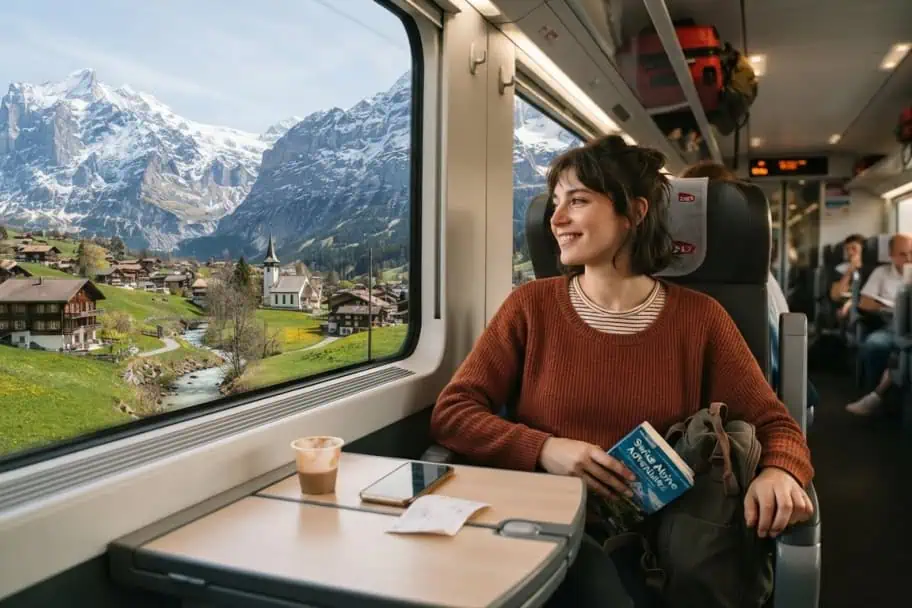
In this guide, you’ll learn everything you need to know about traveling by train in Europe, including how to choose the right tickets and passes, book reservations, navigate train stations, cross international borders, and make the most of your onboard experience. Whether you’re planning your first European rail vacation or looking to refine your travel strategy, this guide will help you explore the continent with ease.
| READ MORE: |
 |
| Planning the Logistics of Your Trip |
Why Choose Train Travel in Europe?

Europe’s rail system is one of the most efficient, comfortable, and enjoyable ways to explore the continent. Whether you’re visiting iconic capitals, charming villages, or breathtaking mountain destinations, trains offer a convenient way to travel between destinations while enjoying the scenery along the way.
For many travelers, the ability to travel by train in Europe transforms the journey into an attraction itself rather than simply a means of transportation. From high-speed connections between major cities to regional lines serving remote destinations, Europe offers rail options for every type of itinerary.
Fast and Efficient Transportation
One of the main reasons travelers choose rail transportation is speed and convenience. Modern trains connect thousands of destinations across dozens of countries, making it easy to create flexible itineraries without the stress of driving or the delays often associated with air travel.
Extensive rail network
Europe boasts one of the world’s most comprehensive rail systems, with train routes connecting major cities, smaller towns, and popular tourist destinations. In many countries, trains operate frequently throughout the day, allowing visitors to travel with minimal planning. These extensive connections are among the best tips for Europe train travel for first-time visitors because they make spontaneous adventures possible.
City center to city center convenience
Unlike airports that are often located far from urban centers, most train stations are situated in the heart of the city. Travelers can step off a train and begin exploring almost immediately, saving both time and transportation costs while making travel by train in Europe incredibly efficient.
Reduced airport hassles
Train travel eliminates many of the inconveniences associated with flying. There are generally no lengthy security lines, baggage claim delays, or boarding procedures. Passengers can arrive at the station shortly before departure and enjoy a smoother travel experience from start to finish.
Scenic Journeys
Many of Europe’s most beautiful landscapes can be experienced from a train window. Routes wind through the Swiss Alps, across the Austrian countryside, along Mediterranean coastlines, and through rolling vineyards and historic villages. Scenic rail journeys allow travelers to appreciate destinations that might otherwise be missed when flying overhead. Some of the best Europe train travel tips involve selecting routes known for their views so the journey becomes a memorable part of the vacation.
Most Popular Scenic Train Rides in Europe
- Glacier Express (Switzerland) – Panoramic journey through the Swiss Alps between Zermatt and St. Moritz.
- Bernina Express (Switzerland & Italy) – UNESCO-listed route featuring glaciers, mountain lakes, and alpine scenery.
- Flåm Railway (Norway) – One of the world’s steepest railways with spectacular waterfalls and fjord views.
- Bergen Railway (Norway) – Scenic route crossing Norway’s mountains and high plateaus between Oslo and Bergen.
- West Highland Line (Scotland) – Famous for dramatic Highland landscapes, lochs, and the Glenfinnan Viaduct.
- Rhine Valley Railway (Germany) – Travels alongside the Rhine River past castles, vineyards, and historic towns.
- Douro Line (Portugal) – Stunning views of terraced vineyards and the Douro River wine region.
- Belgrade to Bar Railway (Serbia & Montenegro) – Spectacular route through mountains, canyons, tunnels, and bridges.
- Cinque Terre Railway (Italy) – Connects the colorful coastal villages of Cinque Terre with Mediterranean views.
- Semmering Railway (Austria) – Historic UNESCO World Heritage railway featuring alpine scenery, viaducts, and tunnels.
Sustainable Travel Option
Rail travel is widely considered one of the most environmentally friendly transportation methods available. Trains generally produce lower emissions per passenger than airplanes and private vehicles. Travelers who want to reduce their environmental footprint while still exploring multiple destinations often choose to travel by train in Europe as a more sustainable alternative.
Understanding Europe’s Rail Network
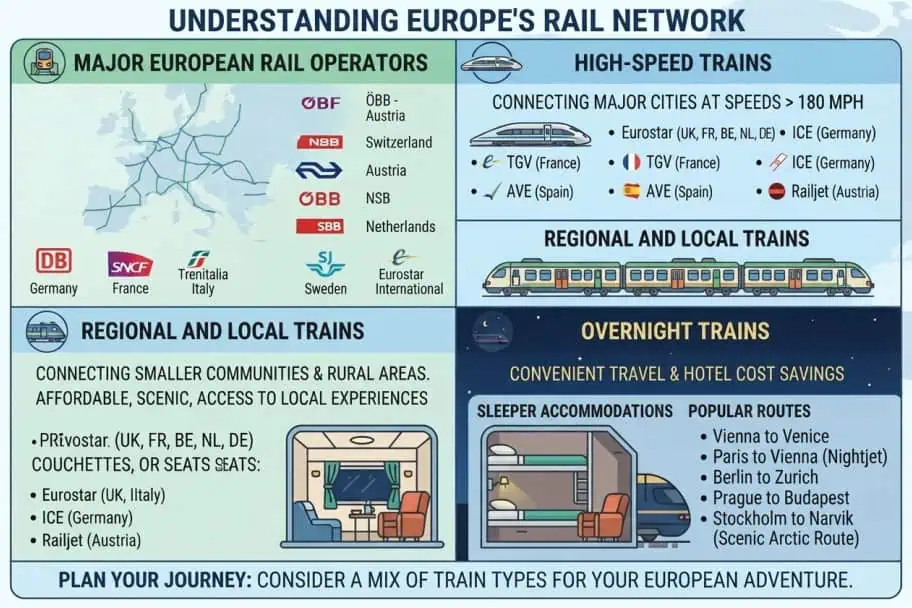
Europe’s rail network includes everything from high-speed international services to local commuter trains. Understanding the different types of trains available can help travelers select the most appropriate options for their itinerary, budget, and travel style.
Major Rail Operators
Most European countries operate their own national railway systems while cooperating with neighboring countries on international routes. Travelers may encounter different booking systems and train brands depending on the countries they visit, but the overall experience remains relatively consistent across the continent.
Major European Rail Operators
- Major European Rail Operators
- Deutsche Bahn (DB) – Germany
- SNCF – France
- Trenitalia – Italy
- Renfe – Spain
- ÖBB (Austrian Federal Railways) – Austria
- SBB (Swiss Federal Railways) – Switzerland
- NS (Nederlandse Spoorwegen) – Netherlands
- SNCB/NMBS – Belgium
- SJ (Swedish Railways) – Sweden
- Eurostar – International routes connecting the United Kingdom, France, Belgium, the Netherlands, and Germany
High-Speed Trains
High-speed trains are among the fastest and most comfortable ways to move between major cities. They often reach speeds exceeding 180 miles per hour and provide modern amenities such as Wi-Fi, power outlets, and onboard dining.
- Eurostar – Connects London with destinations in France, Belgium, and the Netherlands.
- TGV – France’s premier high-speed rail service.
- AVE – Spain’s extensive high-speed train network.
- Frecciarossa – Italy’s flagship high-speed service.
- ICE – Germany’s modern intercity express trains.
- Railjet – Austria’s premium long-distance rail service.
These services make travel by train in Europe competitive with flying on many popular routes.
Regional and Local Trains
Regional and local trains play an important role in connecting smaller communities and rural destinations. While they are typically slower than high-speed services, they often provide access to places that cannot be reached directly by express trains. Budget-conscious travelers frequently use regional trains to save money while enjoying authentic local experiences.
Overnight Trains
Overnight trains offer a convenient way to cover long distances across Europe while making the most of your vacation time. Instead of spending an entire day traveling between destinations, you can board in the evening and arrive in a new city the following morning. For many travelers who want to travel by train in Europe, sleeper services provide an efficient alternative to short-haul flights and long daytime rail journeys.
Many overnight routes feature modern accommodations and comfortable onboard amenities, making the journey part of the experience. One of the most useful Europe train travel tips is to consider overnight trains when traveling between destinations that are several hours apart. Not only can they save time, but they may also reduce overall travel costs by replacing a hotel night.
Sleeper compartments
Most overnight trains offer a variety of sleeping accommodations. Budget travelers can often choose standard seats or shared couchette compartments with bunk beds, while those seeking greater comfort may prefer a private sleeper cabin. The level of comfort and amenities varies depending on the train operator and route.
Private cabins typically include bedding, reading lights, power outlets, and secure storage for personal belongings. Some premium sleeper compartments even feature private bathrooms and complimentary refreshments. Selecting the right accommodation depends on your budget, desired comfort level, and the length of the journey.
Night travel advantages
One of the biggest benefits of overnight train travel is the efficient use of time. Rather than spending valuable daytime hours traveling, you can sleep through the journey and arrive ready to begin exploring. This can be particularly beneficial for travelers with limited vacation time.
Overnight trains can also help reduce travel expenses by replacing a hotel stay. In addition, many routes arrive directly in city centers, eliminating the need for lengthy airport transfers. The combination of convenience, efficiency, and unique travel experiences makes overnight rail travel an attractive option for many visitors.
Popular overnight routes
Europe offers several popular overnight train routes connecting major tourist destinations and transportation hubs. Travelers can find sleeper services linking cities such as Vienna and Venice, Berlin and Zurich, Prague and Budapest, and Paris and Vienna. These routes allow passengers to cover significant distances while enjoying a comfortable night’s sleep.
Because overnight trains are growing in popularity, sleeper accommodations can sell out well in advance, particularly during summer and holiday periods. One of the best Europe train travel tips for anyone considering a sleeper train is to book reservations as early as possible to secure the best choice of cabins and departure dates.
- Popular Overnight Train Routes in Europe
- Vienna to Venice – A classic overnight route connecting Austria’s imperial capital with Italy’s famous canal city.
- Paris to Vienna – A popular Nightjet service linking two of Europe’s most iconic cultural destinations.
- Berlin to Zurich – A comfortable overnight journey between Germany’s capital and Switzerland’s largest city.
- Amsterdam to Vienna – A convenient route connecting the Netherlands with Central Europe.
- Munich to Rome – An overnight service that allows travelers to wake up in the heart of Italy.
- Hamburg to Zurich – A scenic route connecting northern Germany with Switzerland.
- Prague to Budapest – A popular Central European journey linking two historic capitals.
- Brussels to Vienna – An international sleeper route connecting Belgium and Austria.
- Zurich to Prague – An overnight service crossing some of Central Europe’s most beautiful regions.
- Stockholm to Narvik – One of Europe’s most scenic overnight train journeys, traveling through Sweden into the Arctic landscapes of Norway.
Planning Your European Rail Trip

A little planning goes a long way when exploring Europe’s extensive rail network. With thousands of destinations connected by high-speed, regional, and international train services, creating a thoughtful itinerary can help you save time, reduce transportation costs, and avoid unnecessary stress. Before booking tickets, think about how many destinations you want to visit, how much time you have available, and how frequently you want to change locations throughout your trip.
One of the greatest advantages of choosing to travel by train in Europe is the flexibility it provides. You can design an itinerary around iconic capitals, scenic regions, coastal destinations, or cultural hotspots while taking advantage of efficient rail connections.
One of the most important Europe train travel tips is to balance transportation time with sightseeing opportunities, so you spend more time enjoying destinations and less time rushing between them. Another valuable Europe train travel tip strategy is to plan major train journeys before booking accommodations, ensuring your route remains logical and efficient throughout the trip.
Choosing Your Destinations
A little planning goes a long way when traveling through Europe’s rail network. While trains connect thousands of destinations across the continent, creating a well-thought-out itinerary can help you save time, reduce transportation costs, and avoid unnecessary stress. Before booking tickets, consider how many places you want to visit, how much time you have available, and how often you’re willing to move between destinations.
One of the biggest advantages of European rail travel is flexibility. You can build an itinerary around major cities, scenic regions, or specific attractions while taking advantage of extensive rail connections. Whether you’re planning a week-long vacation or a month-long adventure, balancing transportation time with sightseeing opportunities will help you make the most of your trip. Thoughtful planning also makes it easier to choose the right tickets, reserve seats when necessary, and avoid common travel mistakes.
Building an efficient itinerary
An efficient itinerary minimizes unnecessary travel and allows you to spend more time exploring. Instead of jumping back and forth across Europe, try to create a route that moves logically from one destination to the next. For example, travelers exploring Western Europe might continue from Amsterdam to Brussels, then Paris, and onward to Switzerland rather than repeatedly crossing the same regions.
Organizing destinations by geographical proximity often results in shorter travel days and lower transportation costs. It also provides greater flexibility if you decide to make adjustments along the way. A well-planned route helps ensure that train travel enhances your vacation rather than consuming too much of it.
Evaluating travel times
Distance alone does not determine how long a train journey will take. Some cities are connected by high-speed rail services that can cover long distances quickly, while others may require slower regional trains or multiple transfers. Reviewing actual schedules before booking accommodations can prevent unpleasant surprises later.
It’s also important to consider total travel time rather than simply looking at departure and arrival hours. Connection times, station changes, and the frequency of departures can all impact how convenient a route will be. Understanding travel times in advance allows you to create a more realistic and enjoyable itinerary.
Avoiding overly ambitious schedules
One of the most common mistakes first-time rail travelers make is trying to visit too many destinations in a short period. While checking multiple cities off a list may sound appealing, spending every day packing, unpacking, and boarding trains can quickly become exhausting.
A more enjoyable approach is to spend enough time in each destination to fully experience it. Staying two or three nights in most locations allows time to explore major attractions, enjoy local cuisine, and discover areas beyond the main tourist districts. Many experienced travelers consider this one of the best Europe train travel tips because a slower pace often leads to a richer and less stressful travel experience.
Determining Your Travel Style
There is no single “best” way to travel through Europe by train. Some travelers enjoy moving frequently between destinations, while others prefer spending several days in one place. Understanding your preferred travel style can help shape everything from your itinerary and ticket selection to your accommodation choices.
Consider what you hope to gain from the trip. Are you interested in visiting as many famous cities as possible, experiencing local culture at a slower pace, or using one destination as a base for nearby excursions? Identifying your priorities early will make planning much easier and help ensure your trip aligns with your expectations.
Slow travel
Slow travel emphasizes spending more time in fewer destinations. Rather than rushing from city to city, travelers immerse themselves in local culture, explore neighborhoods, and enjoy a more relaxed pace. This style of travel often leads to richer experiences and a deeper appreciation of each destination.
Slow travel can also reduce transportation expenses and travel-related stress. With fewer train journeys to coordinate, travelers have more time to enjoy museums, restaurants, local markets, and day trips without feeling pressured to move on quickly.
Multi-country trips
Europe’s interconnected rail network makes multi-country travel remarkably easy. In many cases, travelers can cross international borders in just a few hours while enjoying comfortable onboard amenities. This makes it possible to experience different cultures, languages, cuisines, and landscapes during a single vacation.
Multi-country itineraries are ideal for travelers who want to see a variety of destinations. However, it is important to plan routes carefully, as crossing several countries in a short period can lead to long travel days and a rushed experience if not managed thoughtfully.
Hub-and-spoke itineraries
A hub-and-spoke itinerary involves choosing one city as a base and taking day trips to nearby destinations by train. This approach allows travelers to unpack once while still exploring a wider region, reducing the hassle of frequently changing hotels. Cities such as Paris, Vienna, Munich, Amsterdam, and Zurich work especially well as rail hubs thanks to their extensive transportation connections.
This travel style offers both convenience and flexibility. Travelers can enjoy a more relaxed pace while still visiting multiple destinations throughout a region. During my own trip to Spain, I used a hub-and-spoke approach to explore several incredible cities while minimizing hotel changes and long packing days. The strategy made the trip far more enjoyable and allowed more time for sightseeing instead of logistics.
If you’re considering a similar approach, I’ve linked my detailed two-week Spain itinerary below. It shows how a carefully planned hub-and-spoke rail itinerary can help you maximize your time, simplify travel, and experience more of a country without constantly moving from one hotel to another.

Understanding Seasonal Considerations
The time of year you travel can affect everything from train availability and ticket prices to crowd levels and overall travel experiences. Summer is generally the busiest season for European rail travel, particularly on high-speed and international routes. Popular departures may require advance reservations, and accommodations often fill quickly during peak travel periods.
Spring and fall are popular alternatives because they typically offer pleasant weather, reduced crowds, and greater availability. These shoulder seasons can provide an excellent balance between favorable conditions and lower costs. Travelers who prefer a quieter experience often find these months especially appealing.
Winter presents its own advantages, including Christmas markets, festive celebrations, snow-covered landscapes, and lower visitor numbers in many destinations. While some seasonal train schedules may be reduced, winter travel can offer unique experiences and savings for flexible travelers. Understanding seasonal patterns allows you to choose the time of year that best aligns with your interests, budget, and travel goals.
Train Tickets and Rail Passes Explained
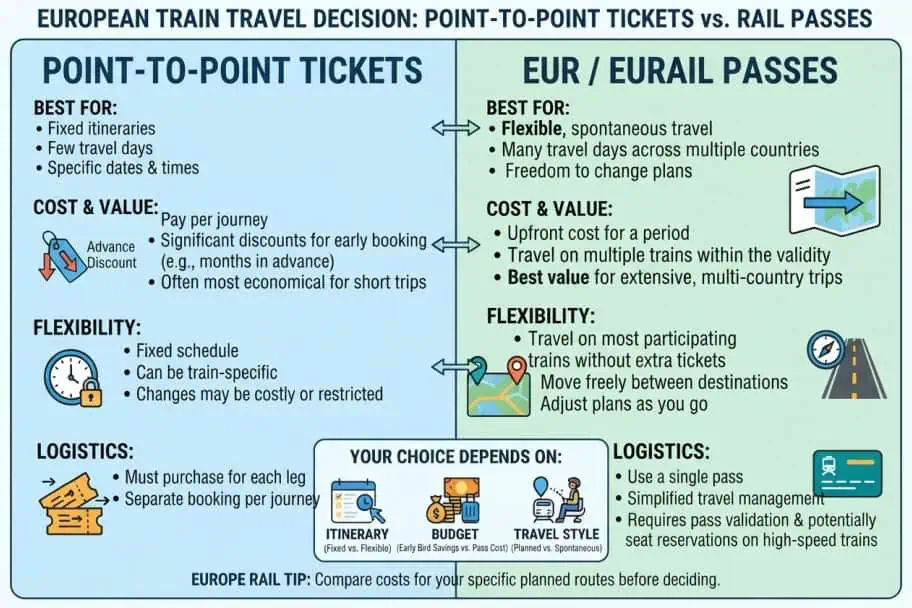
One of the most important decisions you’ll make when planning a European rail adventure is whether to purchase individual train tickets or invest in a rail pass. Both options can provide excellent value, but the right choice depends on your itinerary, budget, and desired level of flexibility. Travelers visiting only a handful of destinations may find advance-purchase tickets to be the most cost-effective solution, while those planning extensive rail journeys across multiple countries often benefit from the convenience of a pass.
Understanding how fares work is an important part of learning how to travel by train in Europe. Ticket prices can vary considerably based on travel dates, demand, train type, and how far in advance reservations are made. One of the most valuable Europe train travel tips is to compare ticket prices and pass costs before committing to either option. Taking the time to research your choices can lead to substantial savings and help you build an itinerary that fits both your budget and travel goals.
Point-to-Point Tickets
Point-to-point tickets are purchased for a specific train journey between two destinations on a designated date and time. They are often the ideal choice for travelers who have a fixed itinerary and know exactly when they plan to travel. Many European rail operators release discounted fares months in advance, rewarding travelers who book early with significantly lower prices.
For shorter vacations or trips that involve only a few rail journeys, point-to-point tickets are frequently the most economical option. They provide access to the same trains, seating classes, and onboard amenities as rail pass holders while avoiding the upfront cost of a pass. One of the most practical Europe train travel tips is to price out your planned routes individually before assuming a rail pass will save money.
Interrail Passes
Interrail Passes (formerly Eurail) are designed for travelers who want flexibility and the ability to move easily between destinations without purchasing separate tickets for every journey. Rather than managing multiple bookings, travelers can use a single pass across participating rail networks in numerous European countries.
An Interrail Global Pass can be especially appealing for travelers planning extensive itineraries that include several countries and frequent train travel. It simplifies logistics and provides the freedom to adjust plans as you go. For travelers who want the flexibility to travel by train in Europe without locking every journey into a fixed schedule, a rail pass can be an attractive option.
How the Interrail Global Pass works
The Interrail Global Pass allows travelers to use participating rail networks across more than 30 European countries with a single pass. After activating the pass, travelers simply add their intended journeys through the Interrail app and use their pass on eligible train services throughout the validity period. Depending on the option selected, travelers can enjoy unlimited train rides on specific travel days while exploring multiple destinations and countries.
While the pass covers a vast network of rail operators, some high-speed trains, international services, and overnight sleeper trains require advance seat reservations. Before departing, travelers should review reservation requirements for each route to avoid unexpected fees or limited seat availability.
Interrail Global Pass Options
The Interrail Global Pass is available in several formats designed to accommodate different travel styles. Most travelers choose a flexi pass, which provides a set number of travel days that can be used within a longer validity period. For example, a pass may allow seven travel days within one month, giving travelers the flexibility to spend several days exploring each destination before moving on.
For those planning a more intensive rail adventure, longer-duration options are available that provide additional travel days and greater flexibility. The variety of pass choices makes the Interrail Global Pass suitable for everything from short European vacations to extended multi-country journeys.
When a pass makes financial sense
A rail pass is often most valuable when traveling long distances, crossing multiple international borders, or maintaining a flexible itinerary. Travelers taking numerous train journeys over a short period may find that a pass costs less than purchasing individual tickets for every route.
However, a pass is not always the cheapest option. Travelers following a fixed itinerary and booking high-speed tickets well in advance may discover that point-to-point fares are less expensive overall. Comparing expected ticket costs against the price of a rail pass before purchasing can help determine which option provides the best value.
Reservation Requirements
Although Europe’s rail network is known for its convenience, not every train can be boarded with a ticket or rail pass alone. Many services require advance reservations, particularly on popular high-speed routes and overnight trains. Understanding reservation requirements before departure can help prevent unnecessary stress and ensure a smoother travel experience.
Reservation policies vary by country, train operator, and service type. Travelers should review reservation requirements as part of their planning process, especially when traveling during peak seasons. Among the most overlooked Europe train travel tips is recognizing that having a valid rail pass does not automatically guarantee a seat on every train.
Routes that require reservations
Many high-speed trains require passengers to reserve seats before departure. This is particularly common on premium services in countries such as France, Spain, and Italy. International routes and overnight sleeper trains also frequently require reservations due to limited capacity and high demand.
During busy travel periods, trains requiring reservations can fill quickly. Even travelers holding a valid rail pass may be denied boarding if all reservable seats have been allocated. Knowing which routes require reservations ahead of time is an important part of planning a successful rail journey.
Additional reservation fees
Reservation fees are often separate from the cost of a rail pass. Depending on the route and train operator, these supplemental charges can range from relatively small fees to more substantial costs for premium high-speed services and private sleeper accommodations.
Because these fees vary across Europe, travelers should factor them into their transportation budget. While a rail pass may provide excellent flexibility, understanding potential reservation costs will help provide a more accurate picture of overall travel expenses.
How to secure seats early
The easiest way to secure preferred departure times and seating options is to make reservations as soon as they become available. Popular routes between major cities can sell out well in advance, especially during summer vacations, holiday periods, and major events.
Many operators allow reservations to be made online before arrival in Europe, making advance planning simple and convenient. Booking early not only increases the likelihood of finding available seats but may also provide more flexibility when selecting travel times, seat locations, and cabin types on overnight trains.
How to Book Train Travel in Europe

Booking rail journeys across Europe is easier than ever thanks to online booking systems, mobile apps, and rail search platforms that make it simple to compare routes and fares. Travelers can purchase tickets directly from national rail operators, use third-party booking platforms to compare options across countries, or combine reservations with a rail pass for maximum flexibility. The best booking strategy depends on your itinerary, budget, and how far in advance you are planning your trip.
Before making reservations, it is worth researching the various ticket options available. Some routes offer substantial discounts for travelers who book months ahead of departure, while others maintain relatively stable pricing throughout the year. One of the most useful Europe train travel tips is to compare multiple booking methods before purchasing.
A little extra research can often save money while helping you find the most efficient route. Whether you plan to travel by train in Europe for a week or several months, understanding the booking process will help you secure the best combination of convenience, flexibility, and value.
Booking Directly with Rail Operators
Many experienced travelers prefer booking directly through the websites and mobile apps of national rail operators. This approach often provides access to the most up-to-date schedules, the widest selection of ticket types, and promotional fares that may not be available through third-party providers. Direct booking can also make it easier to modify reservations, request refunds, and manage travel plans if schedules change.
This method is particularly useful when traveling primarily within a single country. Operators such as SNCF in France, Deutsche Bahn in Germany, Trenitalia in Italy, and Renfe in Spain frequently offer discounted advance-purchase fares that can provide significant savings. One of the most practical Europe train travel tips is to check a rail operator’s official website before booking elsewhere, as you may find lower fares and more ticket options.
Using Rail Booking Platforms
Third-party rail booking platforms have become increasingly popular because they allow travelers to search routes operated by multiple rail companies from a single website. Instead of visiting several carrier websites individually, travelers can quickly compare available routes, departure times, travel durations, and ticket prices in one place.
These platforms can be especially helpful when planning international rail journeys that involve multiple operators. For travelers new to European rail travel, the ability to view various routing options on a single screen can simplify the planning process and make itinerary building much easier.
Popular European Rail Booking Platforms
Popular European Rail Booking Platforms
- Rail Europe – One of the most popular platforms for comparing and booking train tickets across multiple European countries.
- Trainline – A user-friendly platform that compares routes, schedules, and fares from numerous European rail operators.
- Omio – Allows travelers to compare trains, buses, and flights in a single search to find the best travel options.
- Interrail – The official platform for Interrail Passes, reservations, and multi-country rail trip planning.
- Eurostar – Offers booking for its high-speed international services connecting the United Kingdom with France, Belgium, the Netherlands, and Germany.
Comparing schedules
One of the biggest advantages of rail booking platforms is the ability to compare train schedules side by side. Travelers can quickly identify the fastest routes, the fewest connections, and the most convenient departure times without having to search multiple operator websites individually.
Schedule comparison tools can also reveal alternative routes that may be less expensive or more efficient. For example, departing an hour later or making a single connection may result in significantly lower fares while adding very little travel time. Reviewing all available options before booking is one of the most valuable Europe train travel tips for finding the best overall travel experience.
Finding international routes
International train journeys often involve multiple operators, which can make them more complicated to research and book directly. Rail booking platforms simplify the process by displaying complete cross-border itineraries and combining multiple legs into a single search result.
This is particularly useful for routes connecting major cities in different countries, such as Paris and Amsterdam, Vienna and Budapest, or Milan and Zurich. Rather than researching each segment separately, travelers can view all available options, compare travel times, and purchase tickets more efficiently. This convenience makes booking significantly easier for anyone planning to travel by train in Europe across multiple countries.
Mobile Tickets and Paper Tickets
Most European rail operators now offer mobile tickets that can be stored directly on a smartphone. Mobile tickets are convenient because they eliminate the need to print documents, reduce the risk of losing physical tickets, and provide easy access to booking details throughout your journey. Conductors typically scan a barcode or QR code during ticket inspections.
Paper tickets remain available on many routes and may still be preferred by some travelers, particularly those who want a physical backup or are concerned about phone battery life during long travel days. Regardless of ticket type, it is always a good idea to verify ticket requirements before departure and ensure that you have the necessary documentation readily available when boarding. Having both digital and printed copies of important travel information can provide additional peace of mind during your trip.
Understanding Train Classes
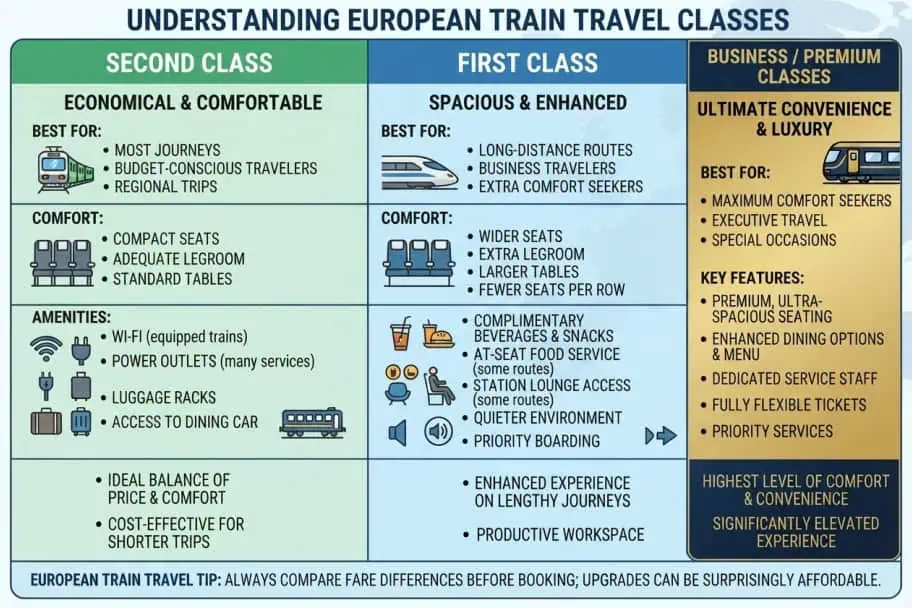
Most long-distance trains in Europe offer multiple travel classes, allowing passengers to select the level of comfort, service, and flexibility that best matches their needs. While exact offerings vary by country and operator, travelers will typically encounter first-class and second-class seating, with some high-speed trains also providing business or premium-class options. Understanding these differences can help you make informed decisions when purchasing tickets and avoid paying for features you may not need.
For anyone planning to travel by train in Europe, choosing the right class can have a noticeable impact on both comfort and budget. On shorter journeys, second class often provides everything necessary for an enjoyable trip, while longer journeys may justify the additional space and amenities found in higher classes. One of the most useful Europe train travel tips is to compare the actual fare difference between classes before booking, as upgrades are sometimes more affordable than many travelers expect.
First Class vs. Second Class
The majority of European trains offer both first-class and second-class seating. While both classes typically provide comfortable seats and access to the same destinations, first class generally offers more space, additional amenities, and a quieter environment.
Second class is by far the most popular option and is used by both locals and tourists throughout Europe. It provides a comfortable travel experience at a lower price point and is more than adequate for most journeys. First class appeals to travelers looking for extra comfort, business travelers who need a productive workspace, or passengers taking longer train journeys where additional room can make a noticeable difference.
Comfort differences
The most noticeable difference between first and second class is personal space. First-class carriages typically feature wider seats, additional legroom, larger tables, and fewer seats per row. This creates a more spacious and relaxing environment, particularly on journeys lasting several hours.
Second-class seating is generally more compact but remains very comfortable by international standards. Modern high-speed trains often provide excellent seating regardless of class, and many travelers find second class perfectly adequate for regional and medium-distance trips. One of the smartest Europe train travel tips for budget-conscious travelers is to reserve first class primarily on longer routes where the added comfort can be fully appreciated.
Amenities and services
Amenities vary by train operator, but first-class passengers often enjoy benefits beyond larger seats. Depending on the route, these may include complimentary beverages, at-seat food service, access to station lounges, quieter carriages, or priority boarding. Some high-speed trains also provide larger workspaces and more convenient power outlet access in first class.
Second-class passengers still receive access to most of the train’s core amenities, including restrooms, luggage storage areas, Wi-Fi on equipped trains, dining cars, and power outlets on many services. While first class may offer additional conveniences, second class remains well-equipped for comfortable travel throughout Europe.
Value considerations
Determining whether first class is worth the extra cost depends on the specific route, journey length, and price difference. On shorter trips, the benefits may be relatively modest, making second class the better value. On longer journeys, however, extra legroom, a quieter environment, and upgraded services may significantly enhance the travel experience.
Travelers should always compare fares before booking because promotions and discounts can sometimes make first-class tickets surprisingly affordable. In some cases, upgrading costs only slightly more than a standard fare. For many travelers who regularly travel by train in Europe, second class offers the ideal balance between affordability and comfort, while first class becomes most attractive on lengthy or special journeys.
Business and Premium Classes
Some European rail operators offer travel categories above traditional first class. These may be marketed as Business Class, Premium Class, Executive Class, Club Class, or other operator-specific names. These upgraded products are most commonly found on high-speed rail services and are designed for travelers seeking the highest level of comfort and convenience.
Business and premium classes frequently include spacious seating, complimentary refreshments, enhanced dining options, lounge access, quieter environments, and priority boarding. Certain operators also provide fully flexible tickets, dedicated service staff, and expanded workspaces designed for productivity during travel. These upgrades are particularly appealing to business travelers and passengers undertaking long rail journeys.
Although premium-class tickets usually cost considerably more than standard first-class fares, they can offer a noticeably elevated travel experience. One of the most valuable Europe train travel tips is to carefully review what is included in the upgrade before purchasing. For most leisure travelers, first class provides ample comfort, while business and premium classes are best suited for those seeking maximum convenience, luxury, and flexibility throughout their journey.
Navigating European Train Stations
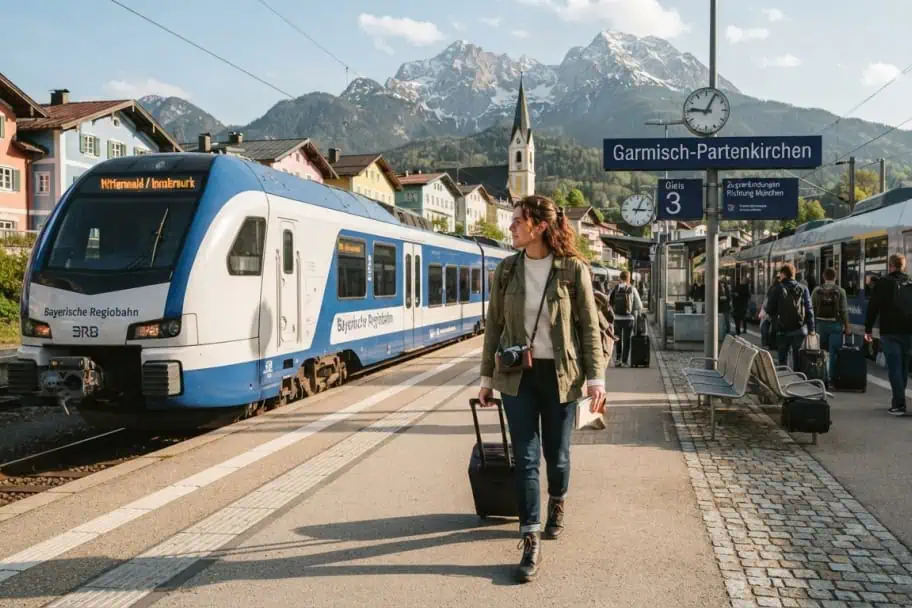
European train stations range from small local terminals to massive transportation hubs that handle hundreds of arrivals and departures each day. While some of the larger stations may appear overwhelming when you first arrive, they are generally designed to move passengers efficiently between trains, public transportation systems, and nearby city centers. Understanding how stations operate can make your journey smoother and reduce stress, especially if you’re visiting multiple countries or navigating connections for the first time.
Most major stations feature electronic departure boards, clear signage, ticket offices, waiting areas, and a wide range of traveler services. Compared to airports, train stations typically involve fewer procedures and shorter waiting times, allowing passengers to move from the entrance to their departure platform relatively quickly. One of the most helpful Europe train travel tips is to familiarize yourself with station layouts and departure board formats before your journey. This can make it much easier to navigate unfamiliar stations and avoid last-minute confusion.
Finding Your Platform
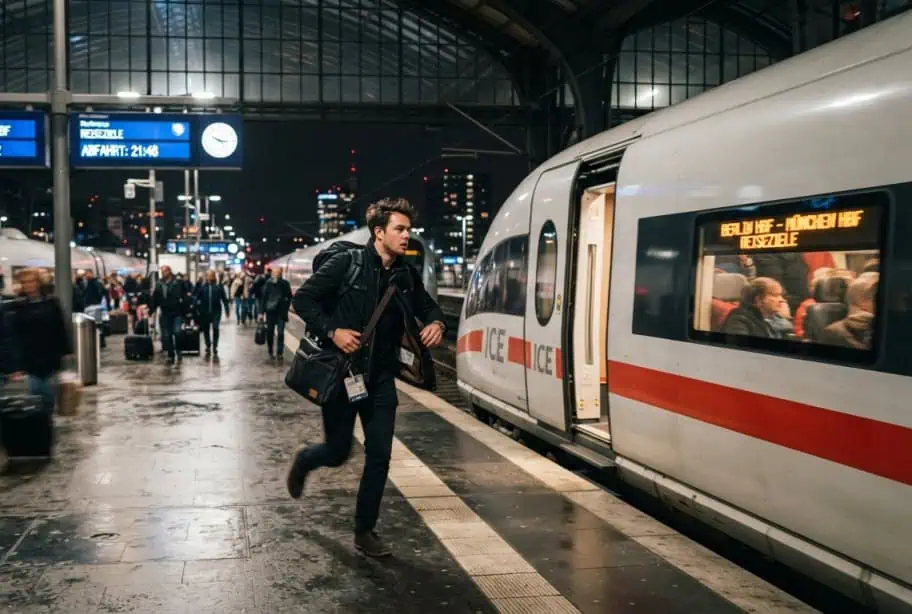
One of the first things you’ll need to do when arriving at a station is locate the correct platform for your train. Most European stations display departure information on large electronic boards that list train numbers, destinations, departure times, and platform assignments. Because some trains continue beyond your destination, it’s usually best to verify the train number in addition to the destination shown on the board.
In larger stations, platform assignments are sometimes posted only shortly before departure. Keeping an eye on departure boards and listening for announcements can help you stay informed if changes occur. Once a platform is assigned, signs throughout the station typically make it easy to find the correct track. Travelers who travel by train in Europe frequently often find that station navigation becomes second nature after just a few journeys.
Station Facilities
Many major European train stations function as transportation hubs and shopping centers combined. In addition to ticketing services, travelers often have access to restaurants, cafés, convenience stores, pharmacies, luggage storage facilities, ATMs, currency exchange services, and public restrooms. Some larger stations even feature supermarkets, hotels, and tourist information offices.
Rail passengers traveling in first class or premium classes may also have access to dedicated lounges where they can relax before departure. These lounges often provide comfortable seating, charging stations, Wi-Fi access, refreshments, and quieter environments away from the main station crowds. Taking advantage of available station facilities can make longer layovers and waiting periods far more comfortable.
Arriving Before Departure
One of the advantages of rail travel is that passengers usually don’t need to arrive as early as they would for a flight. For most domestic and regional routes, arriving 20 to 30 minutes before departure is generally enough time to find your platform, purchase snacks, and board comfortably.
For larger stations, international journeys, or travel during busy holiday periods, arriving 30 to 45 minutes early is often a smart choice. The extra time allows you to navigate unfamiliar surroundings, locate your platform without rushing, and handle any unexpected changes. Another valuable Europe train travel tips recommendation is to give yourself additional time whenever you’re carrying heavy luggage or making a connection in a major rail hub. A relaxed start can make the entire experience of travel by train in Europe far more enjoyable.
What to Expect Onboard
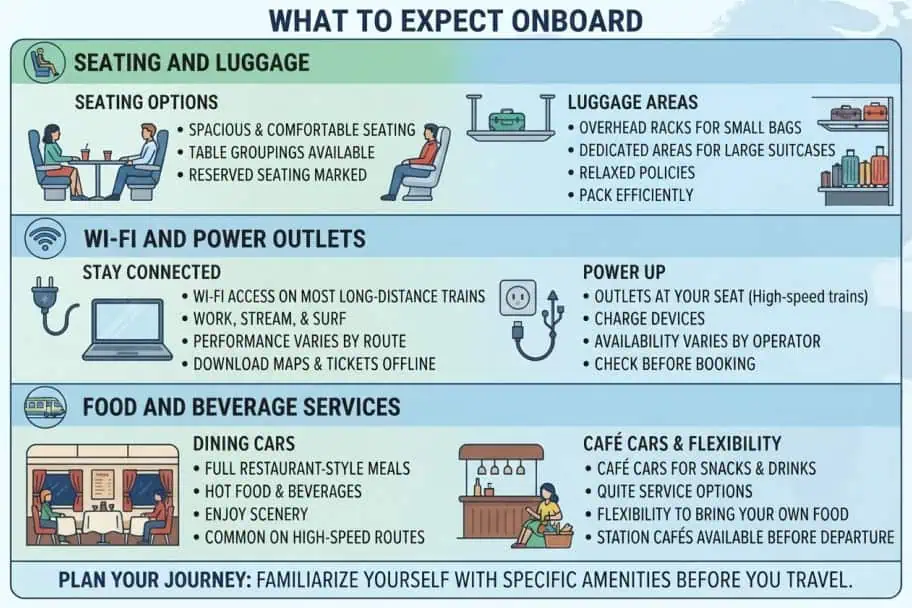
One of the reasons rail travel is so popular throughout Europe is the comfortable and relaxed onboard experience. Unlike air travel, passengers generally have more room to move around, stretch their legs, and enjoy the journey itself. Whether you’re riding a regional train for a short trip or taking a high-speed service between major cities, most trains are designed with passenger comfort and convenience in mind.
The onboard experience can vary depending on the operator, route, and class of service, but travelers can typically expect comfortable seating, generous baggage policies, dining options, and amenities such as Wi-Fi and power outlets. For travelers planning to travel by train in Europe, understanding what to expect before boarding can help make longer journeys more comfortable and enjoyable. One of the most useful Europe train travel tips is to familiarize yourself with the amenities offered on your specific train before departure so you can pack and plan accordingly.
Seating and Luggage
European trains are designed to accommodate a variety of travelers, from commuters and families to business travelers and tourists carrying luggage. Seating is generally more spacious than airline seating, and passengers are free to stand up or walk through most trains during the journey.
Luggage policies are also much more relaxed than what travelers may be accustomed to when flying. In most cases, there are no baggage claim procedures or strict weight restrictions, making rail travel particularly convenient for longer vacations and multi-city itineraries.
Luggage allowances
Most European rail operators allow passengers to bring a reasonable amount of luggage without paying additional fees. Unlike airlines, travelers are rarely required to check bags, and there are often no formal weight limits for standard baggage. As long as you can safely carry your belongings on and off the train yourself, they are generally permitted onboard.
That said, it is still wise to pack efficiently. Trains can become busy during peak travel periods, and managing oversized luggage may be more difficult when boarding, changing trains, or navigating crowded stations. Keeping your luggage manageable will make your overall travel experience much more comfortable.
Storage areas
Most trains provide multiple luggage storage options throughout the carriages. Smaller bags can usually be placed in overhead racks above your seat, while larger suitcases may be stored in dedicated luggage areas located near the ends of each rail car.
When traveling with valuables such as electronics, passports, or cameras, it is best to keep those items with you rather than placing them in a communal storage area. Many travelers choose seats that allow them to keep an eye on their larger bags throughout the journey for added peace of mind.
Seat configurations
Seat layouts vary depending on the train type and route. Many trains feature airline-style seating with rows facing forward or backward, while others offer table groupings that allow families and friends to sit together. Some long-distance services also include quiet cars, family sections, or private compartments.
On high-speed trains, travelers may find more spacious seating arrangements designed for comfort during longer journeys. Regardless of configuration, reserved seats are clearly marked on most services, making it easy to find your assigned place when boarding.
Wi-Fi and Power Outlets
Modern rail travel increasingly includes onboard technology designed to keep passengers connected throughout their journey. Many trains offer Wi-Fi access and power outlets, allowing travelers to work, stream entertainment, charge devices, or stay connected while traveling between destinations.
These amenities are particularly useful for longer journeys where passengers may want to catch up on work, plan activities for upcoming destinations, or simply enjoy entertainment during the ride. Another valuable Europe train travel tips strategy is to download maps, tickets, and important travel information before departure in case connectivity is limited along the route.
Availability by operator
Wi-Fi and power outlet availability differ among operators and train types. High-speed trains are the most likely to offer complimentary internet access and charging ports at every seat. Many premium and first-class carriages may provide enhanced connectivity and additional work-friendly features.
Regional and local trains are less consistent. Some newer regional services offer onboard Wi-Fi and USB charging ports, while older trains may provide few or no connectivity features. Checking available amenities before booking can help avoid surprises on longer journeys.
Connectivity expectations
Even when Wi-Fi is available, performance can vary throughout the trip. Fast-moving trains, mountain regions, tunnels, and rural areas may occasionally interrupt internet connectivity. Travelers planning to work online should be prepared for occasional slowdowns or brief service interruptions.
For this reason, it is a good idea to download entertainment, save boarding passes, and store maps offline before departure. Doing so ensures you can continue your journey without relying entirely on an internet connection.
Food and Beverage Services
Food options onboard European trains range from simple snack services to full restaurant-style dining experiences. The level of service depends on the train operator, route length, and class of travel, but most long-distance services provide some type of food and beverage option.
Passengers are generally free to move between rail cars, visit dining facilities, and enjoy refreshments throughout the trip. Having access to meals, snacks, and beverages can make longer journeys far more comfortable and convenient.
Dining cars
Many long-distance and high-speed trains include dining cars where passengers can purchase hot meals, beverages, and snacks. These restaurant-style cars provide seating separate from the main passenger areas and offer a pleasant place to enjoy a meal while watching the scenery pass by.
Menu options vary by operator but often include sandwiches, salads, hot entrees, coffee, beer, wine, and desserts. Dining cars are particularly popular on journeys lasting several hours, providing a welcome break from sitting at your seat.
Café cars
Trains that do not offer full dining cars often include café cars or snack bars. These smaller service areas typically sell light meals, snacks, pastries, sandwiches, and a selection of hot and cold beverages.
Café cars provide a quick and convenient option for travelers who want refreshments without committing to a full meal. They are commonly found on both high-speed and long-distance services throughout Europe.
Bringing your own food
One of the benefits of choosing to travel by train in Europe is the flexibility to bring your own food and beverages onboard. Unlike many other forms of transportation, rail operators generally allow passengers to enjoy their own meals during the journey.
Many travelers purchase sandwiches, pastries, snacks, or drinks at station cafés and bakeries before departure. Bringing your own food can help reduce travel costs and ensure you have access to meals that suit your personal preferences. This can be especially useful on regional routes, overnight trains, or journeys with limited onboard dining options.
Crossing International Borders by Train
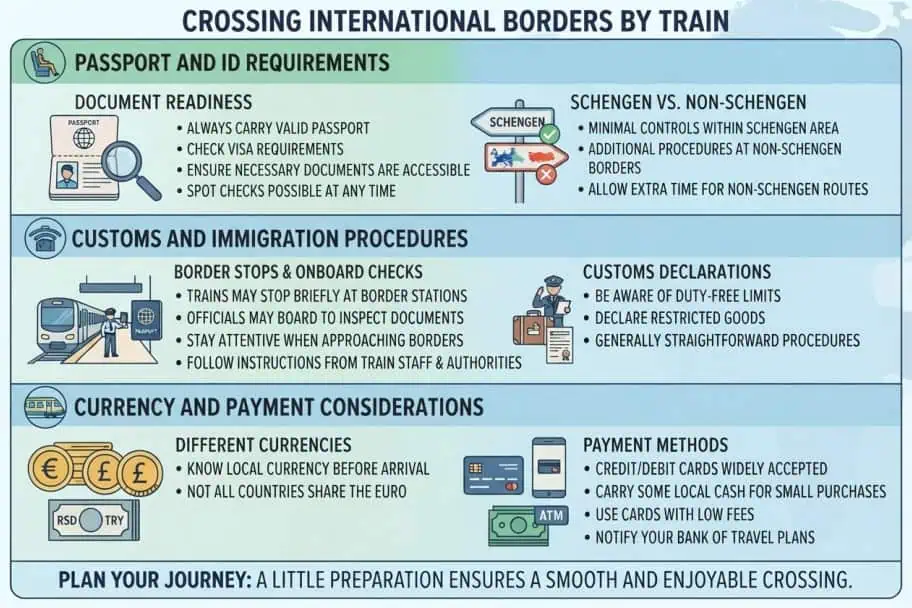
One of the greatest advantages of European rail travel is how easily travelers can move between countries. Many international routes connect major cities across national borders, allowing passengers to travel comfortably without many of the inconveniences associated with air travel. In some parts of Europe, border crossings can feel almost seamless, making it possible to enjoy the scenery and relax while moving from one country to the next.
Even though international rail travel is generally straightforward, travelers should still prepare before departure. Understanding passport requirements, customs procedures, and local regulations can help prevent unexpected issues along the way. For anyone planning to travel by train in Europe, a little preparation goes a long way toward ensuring a smooth and enjoyable journey. One of the most important Europe train travel tips is to verify entry requirements for every country on your itinerary before you leave home, even if border checks seem minimal.
Passport and ID Requirements
When traveling internationally by train, you should always carry a valid passport and any required travel documents, even if border checks are uncommon on your route. Train operators may not routinely inspect identification during boarding, but immigration or border officials may conduct checks at any point during the journey.
Travelers should also verify visa requirements before crossing any international border. Entry requirements can vary based on nationality, destination country, and length of stay. Having all necessary documentation readily available can help avoid delays and complications during your trip.
Schengen Area considerations
Many European countries participate in the Schengen Area, which allows travelers to move between member countries with minimal routine border controls. As a result, train journeys between countries such as France, Germany, Austria, the Netherlands, Belgium, and Italy often feel similar to domestic travel.
Despite the reduced border formalities, travelers should still carry identification at all times. Authorities may conduct spot checks, and accommodations, transportation providers, or local regulations may require proof of identity. Keeping your passport accessible rather than packed deep inside your luggage is always a good idea.
Non-Schengen border crossings
When traveling between Schengen and non-Schengen countries, passengers may encounter additional immigration and customs procedures. Depending on the route, officials may inspect passports onboard the train, at border stations, or before departure.
Examples can include routes involving the United Kingdom, Serbia, Türkiye, and other countries outside the Schengen Area. Procedures vary by destination, so travelers should review the latest border requirements and allow additional time when necessary. One of the most practical Europe train travel tips is to assume that international procedures may take longer than expected and plan accordingly.
Customs and Immigration Procedures
Customs and immigration procedures for rail passengers are generally straightforward. On many international routes, border checks are quick and cause little disruption to the journey. Officials may simply verify passports, review visas when required, or ask a few routine travel questions before allowing passengers to continue.
In some cases, trains may make brief stops at border stations while authorities complete inspections. On other routes, officials board the train and conduct checks as the journey continues. While serious delays are uncommon, travelers should remain attentive when approaching international borders and keep passports, travel documents, and tickets easily accessible. Following instructions from train staff and border authorities will help ensure a smooth crossing.
Currency and Payment Considerations
Although many European countries use the Euro, not all nations share the same currency. Travelers crossing multiple borders may encounter different currencies during a single trip, making it useful to understand local payment practices before arrival. Researching these details in advance can help avoid confusion when making purchases after crossing into a new country.
Credit and debit cards are widely accepted throughout much of Europe, particularly in larger cities, train stations, hotels, and restaurants. However, carrying a small amount of local currency can still be useful when visiting smaller towns, local markets, or businesses that prefer cash payments. Travelers who travel by train in Europe across several countries should also consider using payment cards with low foreign transaction fees and notifying their bank of international travel plans before departure. This small step can help avoid unexpected payment issues and reduce travel-related expenses.
Money-Saving Tips for European Train Travel

Traveling by train in Europe can be surprisingly affordable when you take advantage of the many discounts, passes, and booking strategies available. Some of the best ways to save money include booking tickets well in advance, traveling during off-peak periods, comparing point-to-point fares with rail passes, and considering slower regional trains instead of premium high-speed services. Even small planning decisions can add up to significant savings over the course of a multi-city trip.
It’s also worth comparing ticket prices across different departure times and travel dates, as fares can vary considerably depending on demand. Travelers with flexible schedules often find the best deals, particularly outside of peak summer travel periods. Families, students, seniors, and younger travelers may also qualify for special discounts offered by certain rail operators.
Because there are so many ways to reduce transportation costs, we’ve created a dedicated guide that explores the topic in much greater detail. Be sure to check out the money-saving train travel guide linked below for specific strategies, booking tips, and ways to maximize your rail travel budget.

Safety Tips for Train Travel in Europe
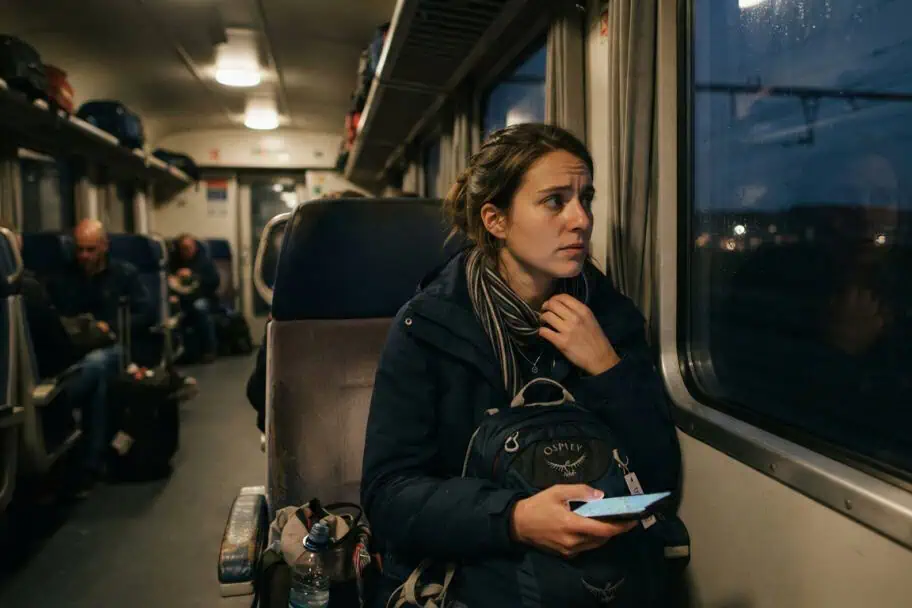
Europe’s rail network is widely regarded as one of the safest ways to travel, and millions of passengers use trains every day without issue. However, as with any form of travel, it is important to remain aware of your surroundings and take basic precautions to protect yourself and your belongings. Keeping valuables secure, paying attention in busy stations, and monitoring your luggage during boarding and disembarking are all simple habits that can help ensure a smooth trip.
Travelers should also familiarize themselves with station layouts, train schedules, and platform information before departure to avoid unnecessary confusion. Keeping important documents such as passports, tickets, and travel insurance information easily accessible can be helpful, particularly when crossing international borders. If traveling overnight, consider using secure luggage storage options and keeping valuables close at hand.
While train travel in Europe is generally very safe, preparation and awareness are always worthwhile. For a deeper look at personal safety, luggage security, common scams, solo travel considerations, and other important topics, be sure to review the detailed train travel safety guide linked below this section.

Don’t Forget to Subscribe to My Adventures!




















Leave a Reply