United States of America Travel
LAST UPDATED: 11/6/25 – United States of America Travel Resources
The United States of America is a very big and diverse place with a wide range of incredible cities, landscapes, and attractions for visitors to see. If you are planning a United States of America travel soon and would like some ideas on where to go, what to see, where to stay, how to get around, and how much time to plan for your trip, you have come to the right place!

Please feel free to use this page as you start to plan your next adventure. To help you navigate the information I have included on this page, I have provided a quick navigation menu for you to use below. This will make it quick and easy for you to see which top destinations I recommend, which popular cities in the United States you should consider visiting, as well as links to all of the travel guides, itineraries, and packing articles that I have written to help you plan your adventure.
I have also included some key information that you will need when planning your United States of America travel. Information such as the languages spoken, the currency used, emergency contact numbers to be aware of, VISA and passport considerations, required vaccinations, and important driving information (if you plan on driving while on your visit).


Top Things to See
Before you start planning your United States of America travel, make sure you check out my gallery of the top things to see in the country below for some inspiration. There is so much to see and do in the country, so you won’t want to miss out on the top sights!
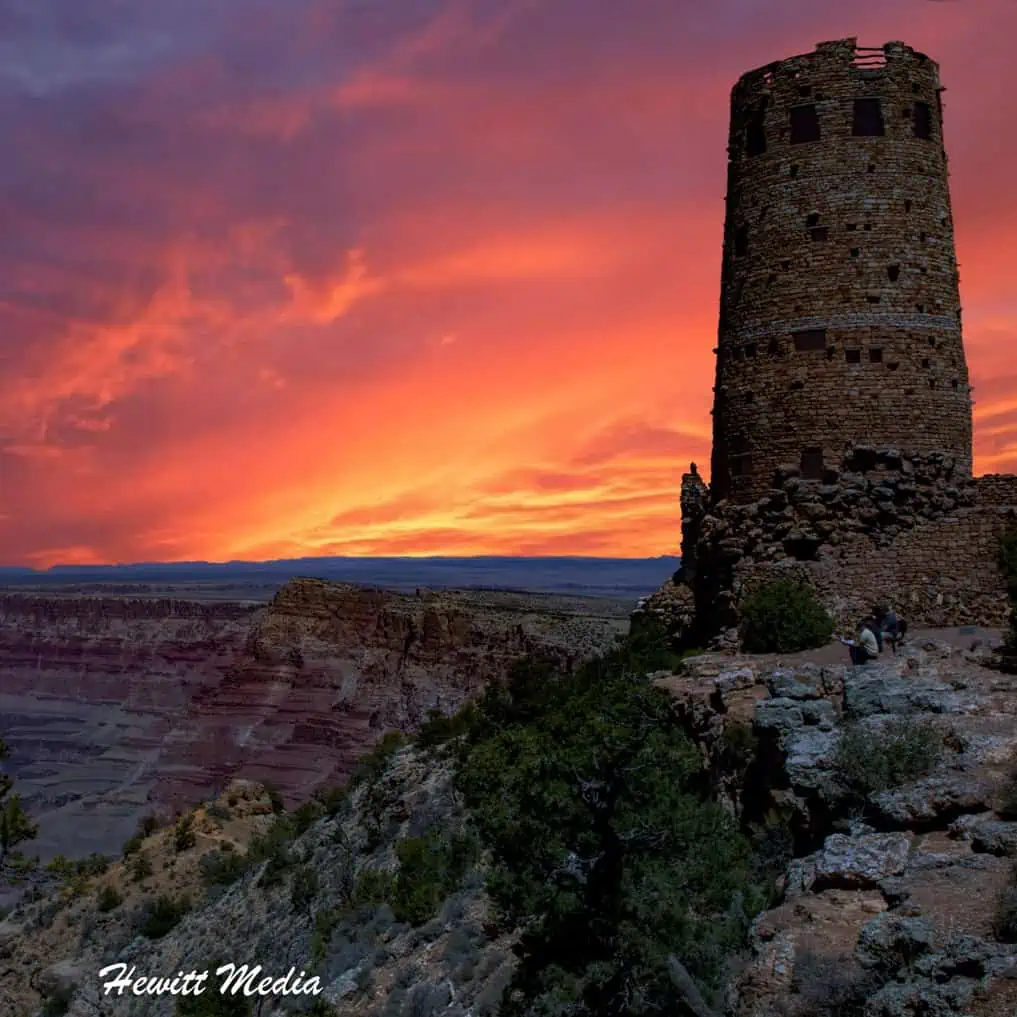
Grand Canyon

Las Vegas
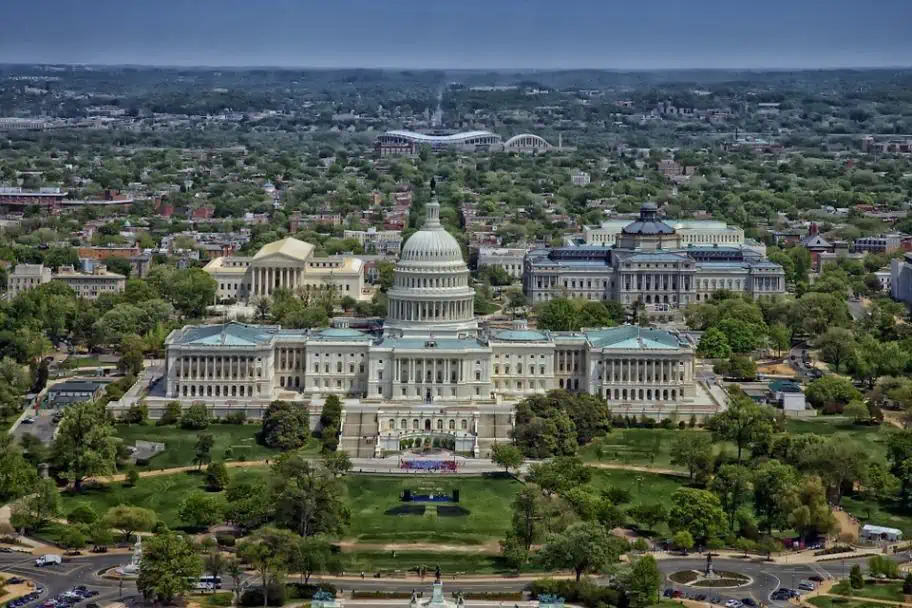
Washington DC

Yellowstone National Park

Hollywood California

Statue of Liberty

Disney World

Waikiki
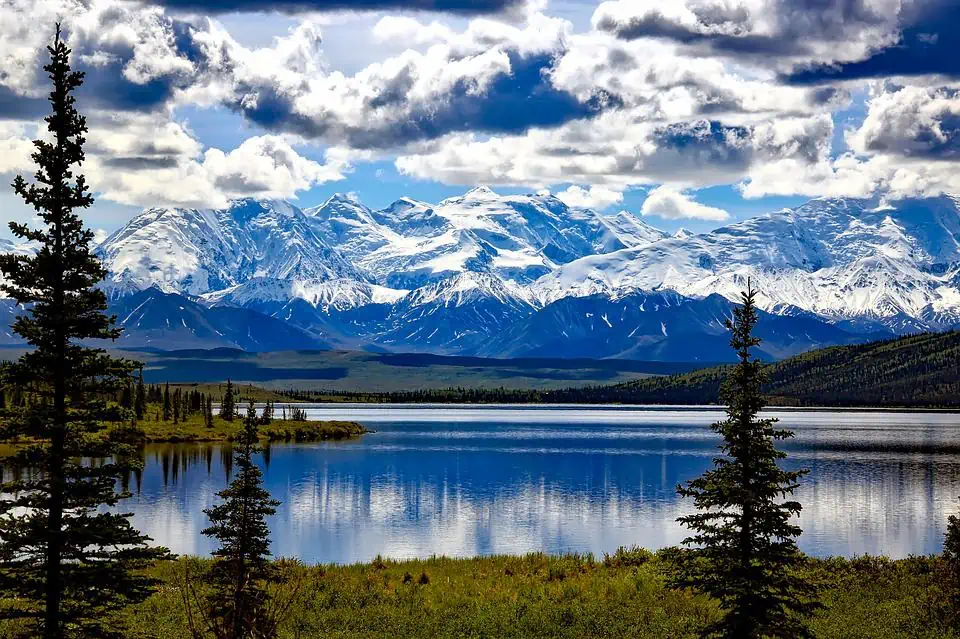
Denali National Park
If you are looking for some additional ideas, please see my Top 50 Things to See in the United States blog series linked below.



State Travel Pages

If you want more in-depth information on travel to any of America’s fifty states, you are in luck. I have created state-specific travel pages that provide detailed guides, itineraries, and information to help you plan your next adventure to the states you want to visit.





Popular Cities

As you start to plan your United States of America travel, you will want to familiarize yourself with the largest and most popular cities (which are not always one and the same) in the country.
Not only to see if you would like to visit and tour these cities, but also because these cities will typically be your ports of entry and transportation hubs as you visit on your trip. To help you with this, I have included a map of some of the key cities within the United States that you will want to become familiar with below.

Languages Spoken
Because the United States is such a large and diverse place, many languages are spoken throughout the country. By far, the most common language spoken in the United States is English. This is the language that most traffic signs, street signs, and building signs will be written in. It is also the language that most Americans speak as their primary language. In fact, roughly 239 million Americans speak English as their first language.
However, depending on where you are within the country or various cities, you may also encounter other languages spoken as well. After English, Spanish is the most commonly spoken language in the United States. Believe it or not, with 41 million Spanish speakers across the country, the United States has the second-highest population of Spanish speakers in the world.
Some of the other languages you will hear spoken in the United States include Chinese (Mandarin, Cantonese, Hokkien, and more), Tagalog (Filipino), Vietnamese, French and French Creole, Arabic, Korean, Russian, and German. In addition to English and Spanish, these other languages round out the Top 10 languages spoken in the United States.
Currency

The recognized currency in the United States of America is the US Dollar ($). Common denominations of the US currency include the $1, $5, $10, $20, $50, and $100 bills. Most ATM machines (cash machines) will dispense currency in combinations of $10, $20, $50, and $100 bills.
In addition, you may also receive change in the form of coins when making purchases with US Dollars. The common denominations of US coins include the Penny ($0.01), Nickel ($0.05), Dime ($0.10), and Quarter ($0.25).
Power Adapters Required

One of the most overlooked aspects of international travel is ensuring you have the proper power adapters. You may or may not be aware that both the voltage and the type of outlet available differ widely from one region of the world to the next. If you aren’t prepared, you won’t be able to charge your electronic devices as you travel.
Even worse, you may damage or even destroy your electronic devices if you don’t have the right adapter with a voltage converter. Electricity supplies worldwide can vary from anything between 100V and 240V. It can be extremely dangerous to use an electrical appliance that is rated at a voltage different from the supply.
To ensure that this doesn’t happen to you, I have included some critical information on the electrical system in the United States for you to review below. This includes what types of international power adapters you should bring with you on your trip.
Electrical Voltage in the United States
In the United States, the voltage of the electrical supply is 120V. If you have an appliance that is single-voltage rated, the voltage rating of the device must be 120V for you to use it without a voltage converter. When shopping for a travel power adapter, it is important to confirm that the adapter you choose has a voltage converter included and isn’t just an adapter.
A power adapter will change the type of plug from one type to another so that you can plug into different outlets. However, a simple power adapter will not change the voltage of the supply to the voltage used by the devices you brought from home (220V-230V outside the United States). To do that, you will need a travel power adapter with a voltage converter.
Electrical Outlets in the United States
In the United States, the two types of electrical plugs that are used are Type A and Type B. The Type A plug is the type with two parallel flat pins. Meanwhile, the Type B plug has two parallel flat pins and a grounding pin. Please see the illustrations of the Type A and Type B plugs below for a better understanding of what they look like.


Emergency Contact
In case of an emergency when traveling in the United States, dial 9-1-1 from any telephone to reach the local emergency services.
Visa, Passport, and Immunization Info

Before booking your United States of America travel, you will want to be sure that you meet all of the necessary passport, VISA, and immunization requirements so that you can ensure you will be allowed into the country. To assist you, I have listed the requirements you will need to consider and linked to my guide to the United States’ entry requirements below for you to review.
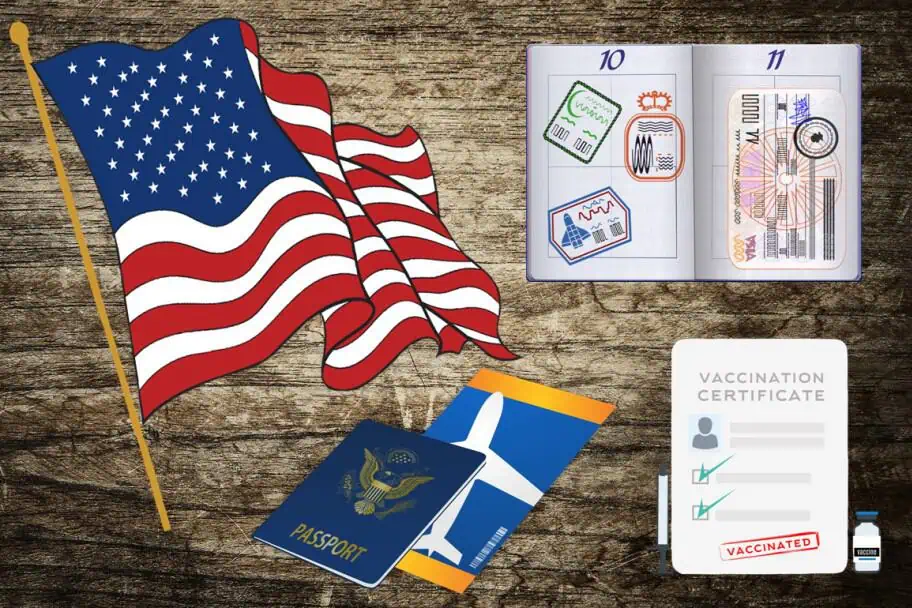
Passport Validity
All visitors must have a passport that is valid for at least 6 months passed the end of their stay in the United States.
VISA Requirements
Per the United States Department of Homeland Security, there are currently 42 countries that are participating in a VISA waiver program with the United States. The Visa Waiver Program (VWP) permits citizens of participating countries to travel to the United States for business or tourism for stays of up to 90 days without a visa.
If you have a valid passport from one of the countries listed below, you will not need to obtain a VISA to enter the United States for your visit.
 |
Andorra |  |
Hungary |  |
New Zealand |
 |
Australia |  |
Iceland |  |
Norway |
 |
Austria |  |
Ireland |  |
Poland |
 |
Belgium |  |
Italy |  |
Portugal |
 |
Brunei |  |
Japan |  |
San Marino |
 |
Chile |  |
South Korea |  |
Singapore |
 |
Croatia |  |
Latvia |  |
Slovakia |
 |
Czech Republic |  |
Liechtenstein |  |
Slovenia |
 |
Denmark |  |
Lithuania |  |
Spain |
 |
Estonia |  |
Luxembourg |  |
Sweden |
 |
Finland |  |
Malta |  |
Switzerland |
 |
France |  |
Monaco |  |
Taiwan |
 |
Germany |  |
Netherlands |  |
United Kingdom |
 |
Greece |
If you do not have a valid passport from one of the countries listed above, you will need to obtain a Tourism (B-2) VISA from the United States State Department.
Immunization Requirements
Currently, the only vaccination requirement to enter the United States is for the Yellow Fever vaccination for travelers who are visiting from a high-risk area. This includes travelers who have had a layover of longer than 12 hours in a high-risk area. I have included some recommendations on general vaccinations and travel vaccinations for the United States below.
Routine Vaccination Recommendations
The following routine vaccinations are recommended for anyone who will be traveling:
- Chickenpox (Varicella)
- Diphtheria-Tetanus-Pertussis
- Flu (influenza)
- Measles-Mumps-Rubella (MMR)
- Polio
- Shingles
Recommended Travel Vaccinations for the United States
In addition to the routine vaccinations above, the following are additional vaccinations you may want to consider for the United States.
- Yellow Fever – The Yellow Fever vaccination is required to enter the United States if you are visiting from a high-risk area or had a layover of greater than 12 hours in a high-risk area while traveling to the USA. Please see the Centers for Disease Control (CDC) map of the areas where a Yellow Fever vaccination is recommended for more details.
- Hepatitis A & B (if you haven’t had them).
- Tetanus (if you aren’t current).
- Flu Shot
- COVID Vaccination (not required for entry but recommended).
Key Phrases to Know
As a part of your United States of America travel preparation, you will need to prepare yourself for how they talk in America so that you can understand the dialogue as you interact with Americans. This includes understanding key phrases and the different regional dialects within this very large and very diverse country.
Here are some common phrases that you may need to use while visiting the United States of America:
- Good Morning – used to greet people early in the day.
- Good Afternoon – used to greet people at midday.
- Good Evening – used to greet people late in the day.
- Thank You (or Thanks for short) – used to express appreciation.
- Hello (or Hi for short) – used to greet people.
- Please – Used to express appreciation when asking for something. For instance, “Can you please help me?”.
- Excuse Me – Used to get someone’s attention or to apologize for an interruption. For instance, “Excuse me, can you help me?” or “Excuse me, sorry for interrupting”.
- I Need Help – Used to get assistance.
- Where Is… – Used to ask for the location of something. For instance, “Where is the bathroom”?
- I Don’t Understand – Used to communicate confusion with an explanation. For instance, “I don’t understand what you are asking for”.
- I’m Sorry – Used to express remorse. For instance, “I’m sorry, I didn’t see you”.
- You’re Welcome – Used to show gratitude for being given thanks. For instance, when someone tells you “Thank you” for something you have done, the proper reply is “You’re welcome”.
- Yes – To express an affirmative response. For instance, “Yes, I would like that”.
- No – To express a negative response. For instance, “No, I would not like to go there”.
- I Am (your name\nationality) – To inform someone of who you are or what nationality you are.
- Call An Ambulance – To request medical assistance. You can also dial 9-1-1 for medical assistance.
- Call The Police – To request law enforcement assistance. You can also dial 9-1-1 for medical assistance.
In addition, here are some key slang terms that you may hear in the United States and what they mean:
- Chill – Another word for relax.
- Oops! – A term used to acknowledge you messed up.
- Dope – A term used to describe something as great.
- Awesome – Another term used to describe something as great.
- Sure – Another word for yes or replying in the positive. For instance, “Sure, I will try one of those”.
- Whatever – A term used to signal a lack of interest in discussing something. For instance, someone might say, “Whatever, I am tired of talking about it”.
- My bad – A slang term for “I’m sorry”.
- Y’all – A phrase often used in the southern states. It is short for “you all”. For instance, “Are y’all in line”?
- Bless Your Heart – This is another term that is often used in the southern states. This term can either be a reply to someone for doing something nice, or a polite way of telling you that you are acting foolishly.
If you would like to familiarize yourself with other important phrases that you will want to know when visiting the United States, please refer to the United States: Important Phrases page on TripAdvisor. For your assistance, I have also linked to my guide on the “Top 10 Things to Know When Visiting the United States for the First Time” below as well.

Driving Info

An important part of your United States of America travel planning will be deciding how you will get around while inside the United States. While it is possible to visit America without renting a car and driving, most visitors choose to rent a car at their destination to get around.
If you are planning on renting a car while visiting the United States, I have included some key information on driving in the United States that you will want to review below.
- Vehicles in the United States have the steering wheel on the left side of the car, and cars drive on the right side of the road.
- To drive in the United States, you must have a valid driver’s license that is in English. If your driver’s license is not in English, you will want to obtain an international driver’s license before your trip to the United States.
- Laws in the United States are split between laws at the federal level (which govern all states) and the state level (which apply to just the specific state). Most traffic laws are set at the state level (including speed limits), so you will want to familiarize yourself with the state driving regulations for the state(s) you will be visiting.
- The legal age to drive in the United States varies by state and ranges from 16 to 18 years of age. Please review the full list of legal driving ages in the United States before arriving in the United States.
- The speed limit in the United States is posted in Miles Per Hour (MPH). As I mentioned above, you will want to be sure to obey all posted speed limits. Failure to do so could result in being fined by the police.
- You will want to be sure to obey all traffic lights and traffic signs. Stop signs signal a need to stop, Yield Signs signal a need to yield to other vehicles, and traffic lights signal a need to stop on Red, prepare to stop on Yellow, and proceed on Green.
- The United States has very strict laws against driving while intoxicated. While the limit on blood alcohol levels varies by state, you should be extra cautious and avoid driving while drinking alcohol, taking prescription painkillers, or using any other legal recreational drugs.
- If you are planning on renting or hiring a car in the United States, there are some things you should be aware of:
- In the United States, car rental companies have no legal obligation to rent or hire a car for you. It is completely up to their discretion.
- Car rental companies typically have a minimum age at which they will rent a car to you and will often charge an extra fee if you are below a certain age. While these ages typically vary from state to state, car rental companies will typically charge you extra if you are under 25 years of age, and will not rent a vehicle to anyone under 21 years of age.
Relative Travel Guides and Articles
To assist you as you start to put together your United States of America travel plans, I have provided a comprehensive list of all of my travel guides, travel itineraries, and travel inspiration articles for the United States for you to review below.






Packing and Planning Tips
Once you start putting together your United States of America travel plans, you may want to reference some of my handy travel packing and planning guides that I have put together. To make it easy to find and access these guides, I have included them for your reference below.








Popular Tours
Exploring the United States offers a treasure trove of captivating tours that cater to every type of traveler. From the breathtaking landscapes of the Grand Canyon to the vibrant streets of New Orleans, there’s an adventure waiting for everyone. Each tour is an opportunity to connect with the culture, history, and breathtaking beauty that make the U.S. a must-visit destination for globetrotters. Whether you’re traveling solo or with family, these popular tours promise to create unforgettable memories.
Don’t Forget to Subscribe to My Adventures!


You must be logged in to post a comment.