LAST UPDATED: 4/22/26 – Jordan Entrance Requirements
If you plan to travel to Jordan, make sure you review the Jordan entrance requirements before you begin organizing your trip. Jordan has strict rules for passports, visas, and immunizations, and travelers who don’t meet these requirements will be denied entry. Handle these steps early—waiting until the last minute could leave you without enough time to resolve any unexpected issues.

To assist you in making sure you meet the necessary requirements to visit Jordan, I have outlined all of the requirements you need to be concerned about in this article. Furthermore, I have also created the handy checklist I linked below for you to use as a point of reference and to track all of the requirements as you meet them.
Download the Jordan Entrance Requirements Checklist
Jordan Passport Requirements

To enter Jordan, your passport must be valid for at least six months beyond your date of arrival. This six‑month validity rule is strictly enforced, and travelers whose passports expire sooner may be denied boarding or refused entry at the border.
Travelers should also be aware of other important considerations:
- Passport condition — Damaged, torn, or heavily worn passports can be rejected at Jordanian border control.
- Blank pages — Jordan typically requires at least one blank page for entry and visa stamps. If you’re transiting through other countries, they may require more.
- Airline rules — Some airlines enforce stricter standards than Jordan itself, including a six‑month validity rule, regardless of destination.
- Transit country rules — If you pass through another country en route, that country’s passport validity requirements also apply.
Before you travel, double‑check your passport’s expiration date and inspect its physical condition. If it’s close to expiring or shows signs of damage, renewing it early is the safest choice to avoid issues at check‑in or border control.
| Passport Validity | Blank Passport Pages |
|---|---|
| At least 6-months beyond arrival date. | 1 blank page required. |
Jordan VISA Requirements

Travelers heading to Jordan will find that entry rules vary widely depending on nationality. Some visitors are completely visa‑exempt; others can obtain permission to enter through a visa-on-arrival; and the remaining travelers must secure a visa in advance. Understanding the Jordan entrance requirements that apply to you helps ensure a smooth arrival and avoids unexpected delays at the border.
| Visa Eligibility | Guidance |
|---|---|
| Visa-Exempt: | Eligible to stay for 1-3 months without a visa. |
| Visa On Arrival: | Must apply for a visa on arrival. You may need proof of accomodation. |
| Other Travelers: | Must apply for an e-visa before traveling to Jordan. |
Visa Exempt Travelers
Visa-exempt visitors can enter Jordan without applying for a visa in advance. This means that citizens of certain countries may stay in Jordan for periods ranging from one to three months—depending on their nationality—without completing any advance paperwork. If you fall into this category, you can simply arrive with your passport and proceed through immigration. A full list of visa‑exempt countries appears below.
 |
Egypt (*) |  |
Oman (**) |  |
Tunisia (**) |
 |
Israel (*) |  |
Qatar (**) |  |
Turkey (**) |
 |
Kuwait (**) |  |
Saudi Arabia (**) |  |
U.A.E. (**) |
 |
Lebanon (**) |
| * – 1-Month |
| ** – 3-Months |
Travelers Eligible for Visa On Arrival
A visa on arrival allows eligible travelers to obtain their entry visa directly at the airport or land border. The process is straightforward: you present your passport, pay the visa fee (typically around 40 JOD), and receive a stamp or sticker in just a few minutes.
You may be asked to show proof of accommodation or onward travel, but the requirements are generally simple. A list of countries eligible for a visa on arrival is provided below. This category represents one of the most common Jordan entrance requirements for short‑term visitors.
 |
Andorra |  |
Hungary |  |
Poland |
 |
Antigua & Barbuda |  |
Iceland |  |
Portugal |
 |
Argentina |  |
Indonesia | |
Qatar |
 |
Armenia |  |
Ireland |  |
Romania |
 |
Australia | |
Israel |  |
Russia |
 |
Austria |  |
Italy |  |
Rwanda |
 |
Azerbaijan |  |
Jamaica |  |
Saint Lucia |
 |
Bahamas |  |
Kazakhstan |  |
Samoa |
 |
Bahrain |  |
Kenya |  |
San Marino |
 |
Barbados |  |
Kiribati |  |
Sao Tome & Principe |
 |
Belarus |  |
Kosovo | |
Saudi Arabia |
 |
Belgium | |
Kuwait |  |
Seychelles |
 |
Bolivia |  |
Kyrgyzstan |  |
Singapore |
 |
Bosnia & Herzegovina |  |
Latvia |  |
Slovakia |
 |
Brazil | |
Lebanon |  |
Solomon Islands |
 |
Brunei |  |
Lesotho |  |
Spain |
 |
Bulgaria |  |
Libya |  |
St Vincent & Grenadines |
 |
Cabo Verde |  |
Liechtenstein |  |
St. Kitts & Nevis |
 |
Canada |  |
Lithuania |  |
Suriname |
 |
Chile |  |
Luxembourg |  |
Sweden |
 |
China |  |
Macau |  |
Switzerland |
 |
Costa Rica |  |
Malawi |  |
Syria |
 |
Croatia |  |
Malaysia |  |
Taiwan |
 |
Cyprus |  |
Maldives |  |
Tajikistan |
 |
Czechia |  |
Malta |  |
Thailand |
 |
D.P.R.K. |  |
Marshall Islands |  |
The Vatican |
 |
Denmark |  |
Mauritius |  |
Tonga |
 |
Dominica |  |
Mexico |  |
Trinidad & Tobago |
 |
Dominican Republic |  |
Micronesia | |
Tunisia |
 |
Ecuador |  |
Monaco | |
Turkey |
 |
El Salvador |  |
Montenegro |  |
Turkmenistan |
 |
Estonia |  |
Nauru |  |
Tuvalu |
 |
Eswatini |  |
Netherlands | |
U.A.E. |
 |
Fiji |  |
New Zealand |  |
U.K. |
 |
Finland |  |
Nicaragua |  |
U.S.A. |
 |
France |  |
Norway |  |
Ukraine |
 |
Georgia | |
Oman |  |
Uruguay |
 |
Germany |  |
Palestine |  |
Uzbekistan |
 |
Guatemala |  |
Panama |  |
Vanuatu |
 |
Guyana |  |
Paraguay |  |
Venezuela |
 |
Haiti |  |
Peru |  |
Zimbabwe |
 |
Honduras |
All Other Travelers
If you are not from a visa‑exempt country and you are not eligible for a visa on arrival, you will need to apply for a visa in advance before traveling to Jordan. This process typically begins online or through a Jordanian embassy or consulate, and it can take anywhere from several days to a few weeks, depending on your location and the type of visa requested.
Below, you’ll find a list outlining the steps required to apply for a visa ahead of time, along with the documents you will need.
Process to Apply for a Visa
- Create an online account — Register on the official Ministry of Interior e‑services portal to begin your application.
- Select your visa type — Choose the appropriate visa category (tourist, business, single‑entry, etc.) based on your travel purpose.
- Complete the application form — Enter your personal details, passport information, travel dates, and accommodation plans.
- Upload required documents — Provide a passport scan, passport‑sized photo, itinerary, proof of accommodation, and any additional documents required for your nationality.
- Pay the visa fee online — Submit payment securely through the portal; fees vary by visa type and nationality.
- Submit your application — Once everything is uploaded and verified, send your application for processing.
- Track your application status — Log in to the portal to monitor progress and receive updates.
- Download your approved e‑visa — When approved, download and print your e‑visa to present upon arrival in Jordan.
The documentation you will need to apply may include the following:
Documentation You May Need
- Passport — valid for at least 6 months beyond your arrival date
- Passport‑sized photos — usually one or two, depending on embassy requirements
- Completed application form — all fields filled accurately
- Travel itinerary — including flight details and expected dates of entry/exit
- Accommodation information — hotel bookings or host address
- Proof of financial means — bank statements or employment verification
- Invitation letter (if applicable) — from a host, organization, or tour operator
- Visa fee payment — amount varies by nationality and visa type
Jordan Immunization Requirements

Routine Travel Vaccinations for Jordan
Important Note: I am not a medical doctor and do not have any medical experience. The information provided in this section is a summary of information that I got from the recommendations of the Centers for Disease Control and Prevention in the United States for travel to Jordan. I am providing you with this information to help bring awareness of the necessary vaccinations to you, but consultation with my guide should not replace a discussion about your travels with your doctor or a travel medical clinic.
One of the most important, and yet most often overlooked, aspects of travel is the necessary vaccinations that are required or recommended to keep you safe and healthy when you travel. Before you depart for Jordan, you are going to want to make sure that you have all of the proper vaccinations.
Some of these vaccinations, like the Yellow Fever vaccination, are included in the Jordan entrance requirements if you are traveling to Jordan from certain high-risk locations. Other vaccinations, such as a flu shot and the Rabies vaccine, are recommended, but not required. For your convenience, I have summarized the CDC’s recommendations on vaccines and healthcare for travelers visiting Jordan for you to review below.
| Vaccination Requirements |
|---|
| For most travelers, no vaccinations are required, but some are recommended. See below for details. |
Recommended Travel Vaccinations for Jordan
There are several vaccinations that the CDC recommends that you get before traveling to Jordan, which I have outlined for you below. If you are traveling to Jordan from a destination where Yellow Fever is common, even if it is only a long layover, then you will be required to show proof of vaccination before you will be allowed into the country. The other vaccinations on this list are not in the Jordan entrance requirements, but they are strongly recommended.
| Vaccine | How Disease Spreads | Details |
|---|---|---|
| Hepatitis A | Food & Water | Recommended for most travelers |
| Hepatitis B | Blood & Body Fluids | Accelerated schedule available |
| Yellow Fever | Thru the bite of infected mosquitoes. | If you are going to be traveling from a country where Yellow Fever is endemic, even if it is only for a layover twelve hours or more, you will need to receive a Yellow Fever vaccination and have certification of that vaccination before you will be allowed into Jordan. |
| Rabies | The saliva of infected animals. Bites or licks on open wounds are the most common vector. | Requires three shots over 21-28 days |
| Typhoid | From food and water you handle or ingest. | Recommended for most travelers, especially those staying with friends or relatives or visiting smaller cities or rural areas. |
| COVID-19 | From being around or coming into contact with someone who is sick. | Depending on Vaccine brand, will require one or two shots over multiple weeks. Everyone 16 years of age and older should get fully vaccinated for COVID-19 before travel. |
| Measles | Various vectors. | Infants 6 to 11 months old traveling internationally should get 1 dose of measles-mumps-rubella (MMR) vaccine before travel. This dose does not count as part of the routine childhood vaccination series. |

Routine Vaccinations for Jordan
In addition to the vaccinations that are recommended for travel to Jordan specifically, there are other routine vaccinations that you should make sure that you are current on before traveling anywhere in the world. For an overview of the routine vaccinations recommended by the CDC, please review the chart that I have included below.
| Disease Name | How Disease Spreads | Advice |
|---|---|---|
| Measles Mumps Rubella (MMR) | Various Vectors | Given to anyone unvaccinated and/or born after 1957. One time adult booster recommended |
| TDAP (Tetanus, Diphtheria & Pertussis) | Thru open wounds & airborne transmission | Only one adult booster of pertussis required |
| Chickenpox | Direct contact with infected individuals & airborne transmission | Given to those unvaccinated that did not have chickenpox |
| Shingles | Direct contact with infected individuals | Vaccine can still be given if you have had shingles. |
| Pneumonia | Airborne transmission | Two vaccines given separately. All 65+ or immunocompromised should receive both |
| Influenza | airborne transmission | Vaccine components change annually |
| Meningitis | Direct contact with infected individuals & airborne transmission | Given to anyone unvaccinated or at an increased risk, especially students |
| Polio | Thru contaminated food and water | Considered a routine vaccination for most travel itineraries. Single adult booster recommended |
Non-Vaccine Preventable Diseases
In addition to the recommended vaccinations, there are other health precautions that you should take when traveling to Jordan to avoid getting sick. While these health precautions aren’t on the list of Jordan entrance requirements, they are important measures that you can take to make sure you don’t get ill while traveling.
AVOID CONTAMINATED WATER
When traveling, one of the easiest ways to get sick is to come into contact with contaminated water. Several illnesses are found in Jordan that can be spread by either drinking or swimming in contaminated water. Before you depart for your trip, you will want to be aware of the illnesses below. To avoid getting sick, make sure you stick to drinking bottled water and avoid swimming in stagnant pools.
| Disease Name | How Disease Spreads | Advice |
|---|---|---|
| Leptospirosis | Touching fluids of infected animal or drinking or swimming in contaminated water | Avoid contaminated water and soil |
AVOID BUG BITES
Another easy way to get sick while traveling is to be bitten by bugs that carry illnesses. The most common insect that spreads diseases to humans is the mosquito, but ticks and flies can also spread serious illnesses through their bites. To make sure you don’t fall ill from an insect bite while in Jordan, I would recommend bringing insect repellent with you when you visit and avoiding getting bitten by bugs as much as possible.
| Disease Name | How Disease Spreads | Advice |
|---|---|---|
| Leishmaniasis | Sand fly bite | Use bug spray and avoid bug bites |

Be aware of airborne illnesses
Out of all the ways that illnesses can be spread, airborne diseases are the hardest to protect yourself against. After all, you don’t have to physically touch or be touched by an infected person or animal, and there isn’t a repellent that you can spray on to avoid catching these illnesses.
This is why it is always important to be observant of those with whom you interact while traveling and make sure you don’t expose yourself to potentially harmful airborne illnesses. According to the CDC, the particular airborne illnesses that you should be aware of while traveling to Jordan are as follows:
| Disease Name | How Disease Spreads | Advice |
|---|---|---|
| Middle East Respitory Syndrome (MERS) | Scientists do not fully understand how the MERS virus spreads. The virus may spread from to others when an infected person coughs or sneezes and may spread to people from camels. | Avoid people who look sick |
| Hantavirus | Coming into contact with bodily fluids or droppings of infected rodents, being biten by an infected rodent, or less commonly from coming into contact with someone else who is infected | Avoid rodents and people who look sick |
| Tuberculosis (TB) | Breathing in the air from an infected individual (via cough, speaking, etc..) | Avoid people who look sick |
Jordan Customs Restrictions
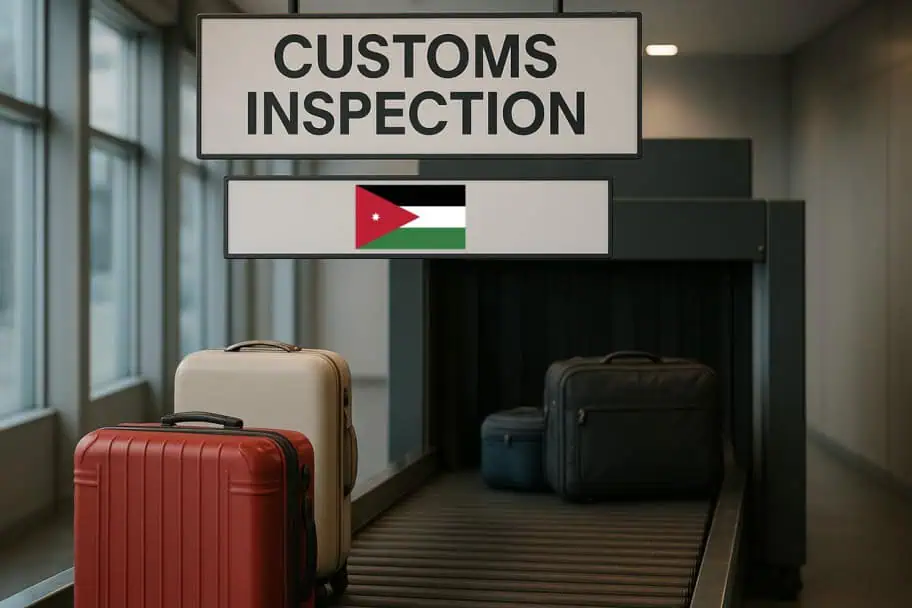
Another important factor to keep in mind when planning a trip to Jordan is understanding the country’s customs regulations. Like many destinations, Jordan restricts or prohibits certain items from entering the country, and travelers who arrive with goods that are not allowed may face delays or penalties. To help you avoid any issues at the border, I’ve outlined Jordan’s customs entry requirements below for easy reference.
| Customs Restrictions |
|---|
| Certain customs restrictions apply when entering Jordan, as outlined below. |
Prohibited Items
Before you are allowed into Jordan, you will also need to clear customs to be sure you aren’t carrying any prohibited items with you. For instance, according to VISAHQ.com, travelers are strictly prohibited from bringing the following items into Jordan:
- Illegal drugs.
- Knives, Weapons, and ammunition.
- Plants and plant products.
- Fresh fruit and vegetables.
- Meat and animal products.
- Israeli currency.
- Counterfeit money and goods.
- Pornographic material.
Controlled Items
In addition to these prohibited items, the government of Jordan has placed limits on the quantity of other items that can be brought into the country. If you plan to travel with any of the following items when visiting Jordan, you will want to plan accordingly so that you do not violate the Jordan entrance requirements:
- 200 cigarettes.
- 25 cigars.
- 200 grams of pipe tobacco.
- 1-liter alcoholic beverages.
- 2 bottles of perfume.
- Legal personal goods up to JOD 50.
Jordan Currency Restrictions

The final aspect of the Jordan entrance requirements that you will want to make sure you comply with when traveling to Jordan is the amount of currency you plan on bringing to the country. When visiting Jordan, like all countries, you can’t just bring any amount of currency that you want into the country when visiting. According to VISAHQ.com, the government of Jordan has the following currency limits and regulations in place:
- The Israeli currency is illegal.
- An unlimited amount of local currency can be brought into the country as long as it is not converted into foreign currency when leaving the country.
- There is no limit on the amount of foreign currency (except Israeli currency) that can enter the country as long as it is declared upon arrival.
Don’t Forget to Subscribe to My Adventures!

Let Me Help You Save On Your Next Adventure!
‘Start Exploring Today’ Merchandise Available Now!
 |
 |
 |
 |
 |
 |
 |



















Fabulous image.
Thank you!!